
Since the democratization of AI on November 30, 2022, the LLMs have been taking over every nook and crook of content marketing. The AI ascendancy that started with producing plain content is now reshaping how users interact with traditional search engines.
Microsoft Copilot was the first AI chatbot to start attributing sources by including links from the original content. As conversations around plagiarism and copyright infringement gained traction, other platforms began implementing similar source attribution. I also had the honor of seeing an AdPushup blog listed as one of the cited references in a Claude.ai response.
Many publishers are seeing the result of this source attribution fine-tuning. 63% of websites are receiving LLM traffic as of February 2025 (Ahrefs). A Digiday article has even reported the spike in ChatGPT traffic going towards publishers’ websites. The story doesn’t end here; it has nearly doubled this year.
Sharing an excerpt from the article:
ChatGPT sent 243.8 million visits to 250 news and media websites in April 2025, up 98% from 123.2 million visits this January, according to David Carr, senior insights manager at data analytics company Similarweb.
Some of the sites that saw the biggest increase change in their share of referral traffic from ChatGPT in April 2025 included The BBC (up 188.9% since January, driving about 118,000 visits), Fox News (up 166.3%, with about 113,000 visits) and The Independent (up 157.7%, with about 80,000 visits), according to Similarweb’s data.
If I were to infer it, the same ChatGPT that was pulling traffic away from publishers is now channeling that traffic toward their websites. That’s the ChatGPT ascendancy, which is gaining traction among publishers and content marketers the most.
Analytics Tools Showing AI Traffic
Observing the penetration of AI in the publishing industry, many analytics tools, such as GA4 and Clarity, have begun to display AI traffic. Even CRMs like HubSpot have also started showing AI-attributed views and leads.
Google Analytics 4
Google Analytics 4 has been showing AI traffic under the “Referral” category since July 2024. Since October 2024, ChatGPT traffic has also been categorized under the “Organic Traffic” category. The event coincides with the introduction of ChatGPT Search, which provides users with real-time, updated responses.
Plus, it isn’t a mammoth task to look for AI traffic in GA4.
GA4 >> Reports >> Lifecycle >> Acquisition >> Traffic Acquisition. From here, select “session source/medium” and you will start seeing the AI traffic attributions. As I wanted to specifically check the ChatGPT-attributed traffic, I simply typed “chatgpt.com” in the search bar.
Circling back to the Digiday article, even our website has seen an increase in the influx of ChatGPT traffic over the last few months. Between Q4 2024 and Q1 2025, we saw an increase of around 1,000%, and the numbers have continued to rise since then.
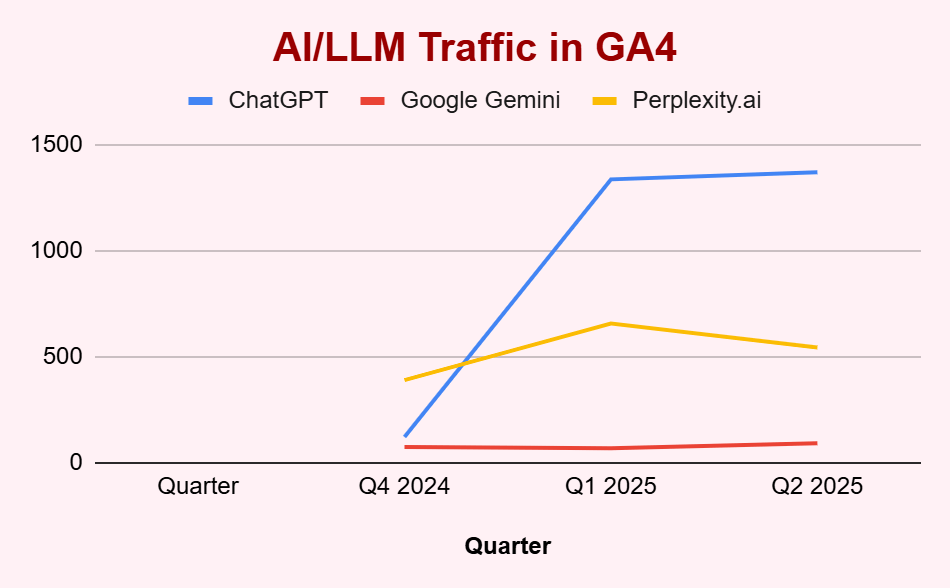
Note: Q2 2025 data is till June 25, 2025.
For deeper insights, you can create a custom LLM report.
Custom LLM Report in GA4
A custom LLM report in GA4 will act as a dedicated dashboard to track and analyze LLM traffic coming to your website.
1. Navigate to “Explore” in the left-hand menu and create a new “Blank” exploration.
2. Navigate to “Segments” under the “Variables” column.
3. Click on “Create a new segment” and select “Session segment”.
4. Now, navigate to “Add new condition” and select the segment “Session source” within “Traffic source”.
5. Click on “Add filter”, select “matches regex” from the drop down and enter the following value:
.*chatgpt.com.*|.*perplexity.*|.*copilot.microsoft.com.*|.*openai.com.*|.*gemini.google.com.*|.*claude.ai.*|.*aitastic.app.*|.*bnngpt.com.*|.*writesonic.com.*|.*copy.ai.*|.*chat-gpt.org.*|.*claudebot.*|.*ai2bot.*|.*ai2bot-dolma.*|.*chatgpt-user.*|.*claude-web.*|.*gptbot.*|.*mistral.ai.*|.*cohere.ai.*|.*huggingface.co.*|.*anthropic.com.*|.*chatglm.cn.*|.*baichuan-ai.com.*|.*zhipu.ai.*|.*palm-ai.google.com.*|.*gemini-api.google.com.*|.*xiaoice.com.*|.*quora.com/poe.*|.*my-ai.snapchat.com.*|.*deepl.com.*|.*you.com.*|.*yiyan.baidu.com.*|.*ai.baidu.com.*|.*amazonbedrock.*|.*anthropic-api.com.*|.*open-assistant.io.*|.*huggingchat.com.*|.*forefront.ai.*|.*character.ai.*|.*chat.suno.com.*|.*deepmind.com.*|.*microsoftazure.ai.*|.*phind.com.*|.*pi.ai.*|.*komo.ai.*|.*vicuna.ai.*|.*firefly.adobe.com.*|.*grok.x.com.*|.*coze.com.*|.*x.ai.*|.*bard.google.com.*|.*lighton.ai.*|.*spellbook.rossintelligence.com.*|.*notion.so/ai.*|.*wordtune.com.*|.*syntesia.io.*|.*hyperwriteai.com.*|.*sap.ai.*|.*reka.ai.*|.*app.loora.ai.*|.*uminal.org.*|.*alphacode.google.com.*|.*ai21.com.*|.*openrouter.ai.*|.*magical.team.*|.*useblackbox.io.*|.*ai-coustics.com.*|.*chinchilla.ai.*|.*d-id.com.*|.*wav.ai.*|.*openchat.so.*|.*floydhub.com.*|.*bing.com/chat.*|.*copilot.azure.com.*|.*turing.microsoft.com.*|.*cosmos.microsoft.com.*|.*orca.microsoft.com.*|.*phi.microsoft.com.*|.*megatron.microsoft.com.*|.*jarvis.microsoft.com.*|.*maia.microsoft.com.*|.*googleother.*|.*gemini.google.com.*|.*palm.google.com.*|.*bard.google.com.*|.*gemini-api.google.com.*|.*alphacode.google.com.*|.*deeplearning.google.*|.*vertexai.google.com.*|.*ai.google.com.*|.*deepmind.google.com.*|.*cloud.google.com/ai.*|.*google-extended.*|.*googleother-image.*|.*googleother-video.*|.*cloud.google.com/vertex-ai.*|.*research.google.com/ai.*|.*ml.googleapis.com.*|.*tensor.google.com.*|.*t5.google.com.* |.*deepseek\.com.*
And click on “Apply”.
6. Once you are done, navigate to “Dimensions” and select “Session source/medium”.
7. Now navigate to “Metrics” and add the events like total users, key events, views, or sessions as your metrics.
This provides configurable analysis for your Exploration reports. It’s perfect for delving further into AI user behavior without changing how data appears in your usual reports.
Microsoft Clarity
Apart from Google Analytics 4, Microsoft Clarity has also started showing AI-attributed traffic under the “Referral” category. It’s visible on the Clarity Dashboard under the “Referral” tab.
Customer Relationship Management (CRM) Platforms
Even CRMs like HubSpot have also started showing AI-attributed views. Going one step further, HubSpot has also begun to attribute AI as the original source for leads generated. This clearly highlights the depth of AI penetration in marketing. One can even call it a defining moment within the LLM traffic legacy.
How Valuable is LLM Traffic?
But is this traffic valuable, you may ask? Initially, Google and Microsoft claimed that AI-generated citations lead to higher-quality clicks. But, a study by Dan Taylor of SALT.agency proved it otherwise. However, the nuances of the report will provide a clearer view.
The LLM traffic (AI traffic) in certain sectors, such as Publishing, Health, and Real Estate, has shown higher engagement compared to the average organic traffic. However, the overall engagement of the LLM has been significantly lower compared to traditional organic traffic. On the other hand, a study by Knotch found that LLM traffic drove conversions 2 times its traffic share compared to organic search traffic, which stood at 1.7 times its share.
The more data you gather, the more contradictory conclusions you will come to. This is quite understandable, as the LLM traffic is still in its nascent stage, and its behavior has yet to be studied comprehensively.
However, amongst the noise, SaaS stood out in terms of conversion rate benchmarks. The data clearly shows that the SaaS conversion rates are nearly identical between LLMs (6.69%) and Organic (6.71%) traffic sources. The difference is hardly 0.02%. Again, this is not an identified pattern and should be treated as an exception.
With that being said, the SaaS numbers do expose certain user behaviors that are worth exploring. To begin with, LLMs/AI chatbots are mainly built for research and answering informational queries. In short, they are ideal for research that requires heavy reading.
SaaS is one of the sectors where a user’s product research builds their purchase intent. They are knowledge-hungry and readily invest time in reading about a product inside-out. Unlike with B2C users, where price and visuals dictate conversions, SaaS users buy based on the product’s actual value.
If a publisher were to look for an ad partner to implement header bidding or for app monetization, they would simply prompt: “Which is the best ad tech company for header bidding?”. In such cases, the LLM model would act like a personal product advisor, referencing comparison blogs, case studies, detailed guides, or e-books.
This is the exact kind of structured content SaaS brands invest in, and LLMs rely on for their output.
It’s safe to say one creates the technical, long-form content; the other serves it.
AI Search Monitoring Tools for Deeper Insights
Diving deeper, I discovered several additional tools that specifically track and analyze AI traffic directed to a website. Some of them include:
Peec AI
Peec AI is an AI-monitoring platform that offers a comprehensive suite of AI-led solutions for brands and publishers seeking to drive AI traffic. Their dashboard offers detailed insights, from prompts and sources to even mentions. It also provides industry rankings and competitor analysis, something that’s worth exploring.
Otterly.AI
Otterly.ai is another platform that websites can employ to optimize their AI traffic. The primary focus of the platform is working on LLM traffic coming from three primary sources: ChatGPT, Google Gemini, and Perplexity.ai. Just like Peec AI, it also lets you know which prompt featured your website link.
Profound AI
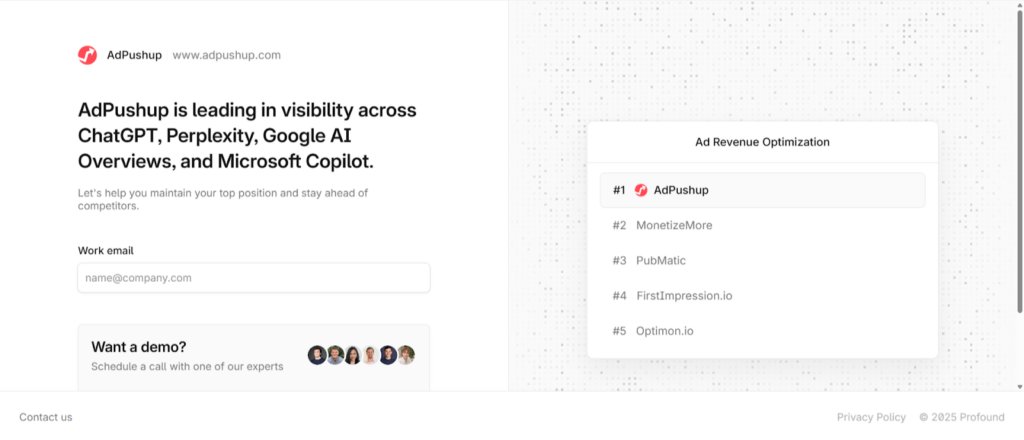
Profound AI covers more ground compared to Otterly.ai by also targeting LLM traffic from Microsoft Copilot. Just like Peec AI, it also offers a detailed and intuitive dashboard that shows brand industry rankings, topics, citations, and the specific LLM. You can analyze your website with Profound AI before opting for a demo to get an idea of which keyword your website is currently LLM-optimized.
Key Takeaways
- According to Digiday, AI-attributed traffic coming from ChatGPT has almost doubled this year. This has been advantageous for publishers as this development provides another area to work on and increase their visibility.
- Analytics tools like Google Analytics 4 and Microsoft Clarity have already started showing LLM traffic under the “referral” section. However, you can fine-tune the reporting by creating custom reports.
- HubSpot, a CRM platform, has also started showing LLM-attributed page views. Moreover, it has also started attribution ChatGPT as the original source for leads.
- As of now, the average LLM traffic is less engaging compared to traditional organic traffic. However, the SaaS industry tells a different story, as LLM traffic conversions are almost the same as organic traffic conversions. This phenomenon is attributed to the user’s purchase intent, which is driven by heavy and detailed research data – something LLMs excel at.
- Several AI search monitoring platforms, including Peec AI, Profound AI, and Otterly.ai, have emerged, providing nuanced insights into LLM traffic and strategies for its growth.
FAQs
You can track LLM traffic using various analytics tools like Google Analytics 4 or Microsoft Clarity. However, to get detailed insights, it’s best to opt for AI search monitoring tools like Peec AI or Profound AI.
The UTM source of ChatGPT is “utm_source=chatgpt.com”. UTM parameters are special codes at the end of URLs that enable Google Analytics to track how visitors arrive at your site. Specifically, utm_source identifies the name of the website, app, publication, ad network, or other entity that sent the traffic.
ChatGPT utilizes a large language model (LLM) called GPT-4 Turbo. This model is an updated version of the original GPT series, featuring multimodal capabilities via GPT-4 Vision, enhanced processing power, and improved accuracy.
It’s quite simple to track referral traffic from ChatGPT. In GA4, you can view GPT traffic in traffic acquisition by selecting “session source/medium” dimension under traffic source. In Microsoft Clarity, you don’t have to navigate much. The traffic can be visible under the “Referral” tab within the dashboard.