

Feeling overwhelmed by online advertising metrics like CPC vs. CPM, and how do other metrics like CPA differ? Let’s break down these terms and compare them so you can choose the right pricing strategy for your publishing business.
Publishers and advertisers certainly have a lot to learn to excel in the ever-changing advertising industry. One important aspect here is learning digital marketing metrics, and with it comes the question: “what is CPC and CPM?”
CPC and CPM are two standard metrics that are used in the advertising industry, and after them comes CPA.
In this blog, we will decode the CPC vs CPM. Although both are important metrics for marketers, they differ in how they measure ad performance and impact campaign goals.
We will also compare the two with CPA to help publishers understand which pricing strategy would suit their publishing business the best.
But first, let’s glance at the basic differences between CPC and CPM.
CPC vs CPM
The CPM model is completely different from CPC in CPM, advertisers are billed for every thousand impressions the ad gets against CPC, where they are only billed for the clicks the ad gets.
Here’s a quick look at how CPC vs. CPM breaks down:
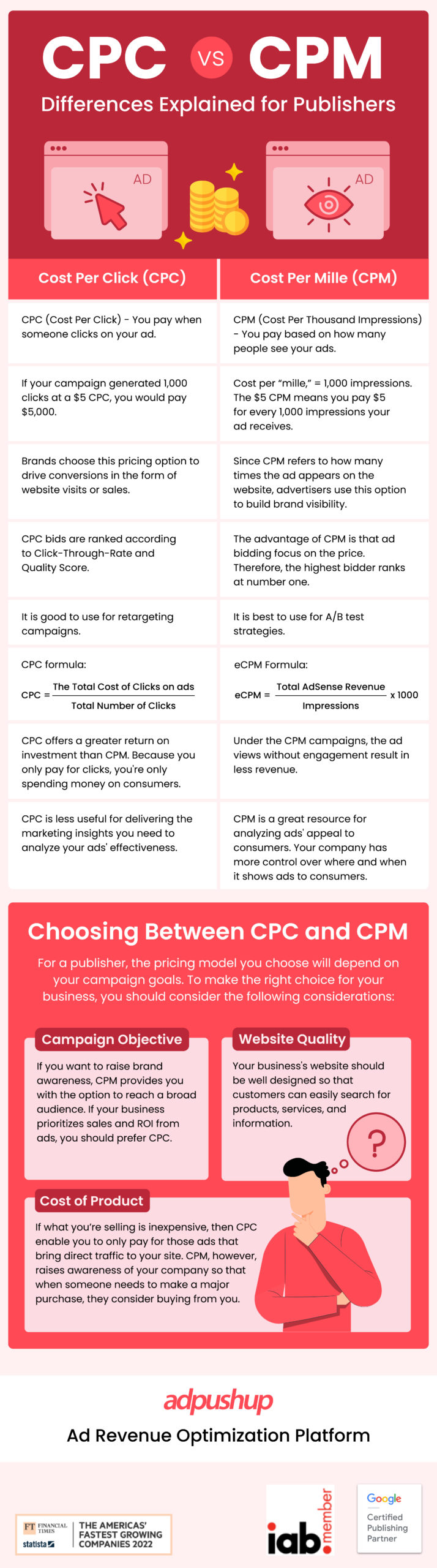
What is CPC in Advertising? (CPC Meaning)
CPC stands for “cost per click.” In this model, the publisher gets a fixed amount each time someone clicks on the ad. For example, if the publisher gets paid $0.40 per click and the ad is clicked 1,500 times, the advertiser will pay the ad network $600 in total for the ad. If fewer people click on your ad, they will pay less.
Let’s take a look at this another way.
For example, if an ad is clicked twice and each click has a price of $1, the total CPC would be $2. It’s that simple!
However, publishers calculate CPC differently. Many publishers and ad networks utilize click bidding for their CPC rates. This means that the rate is not fixed. It is dynamic and depends on the demand for the particular ad space of the publisher at a particular time.
A mechanism is set in place that calculates the cost all the time, based on the demand.
Additionally, publishers also use a formula to calculate CPC: cost per impression (CPI) / percent click-through ratio (%CTR) = CPC
Features:
- Ideal for publishers with high-quality traffic for increased CTR
- Often confused with pay-per-click (PPC), which is an advertising model
- Mainly used to drive traffic to advertiser’s website
- More performance-oriented compared to the CPM model
What is CPM? (CPM Meaning)
CPM stands for “Cost Per Mille.” “Mille” refers to every 1,000 ad impressions. With this model, the advertiser pays a fixed amount for an ad network to show the ad 1,000 times. This price point is not affected by whether or not people click through to the website.
Pricing metric helps you calculate how much money it takes to show an ad a thousand times on a website.
To calculate it, simply divide the spend by the number of impressions. So, if the spend is $1,000, the CPM for 50,000 impressions would be: 1000/50000 x 1000 = $20 .
Features:
- Ideal for publishers with a sustained website traffic flow
- Utilized for advertisers mainly for awareness campaigns to build brand visibility
- Generally, it is a part of a long-term marketing plan as it doesn’t guarantee quantifiable results
- Most common and straightforward model for publishers as it makes easy money
Now that we understand CPM vs CPC, let’s look at CPC vs CPM vs CPA.
What is CPA? (CPA Meaning)
CPA, or cost per acquisition, is another pricing metric in which an advertiser only pays when a user takes an action. This could be a purchase, a subscription, or a free trial signup.
This would pose a risk to the publisher, as they would only be paid if the user took an action from the ad instead of simply clicking or watching it. This is also known as affiliate advertising and was widely used in the mid-2000s.
Features:
- Result-oriented as it focuses on lead or demand generation
- Ideal for publishers with a niche audience for maximized revenue
- Used by advertisers only for highly targeted campaigns to maximize the ROI
- Considered to be of low risk for advertisers as payment is tied to the outcome
- Effective conversions can lead to greater ad revenue for publishers compared to the other two models
Now that we have covered CPA, let’s get on to CPC vs CPM vs CPA comparison.
CPC vs CPM vs CPA
| Feature | CPC | CPM | CPA |
| Full form | Cost per click | Cost per mille | Cost per action/acquisition |
| What is it | Publisher gets paid when the user clicks on the ad | Publisher gets for every thousand impressions an ad gets | Publisher gets paid when the user completes a desired action (purchase, signup) |
| Best for | Best for performance-driven campaigns (e.g., A/B testing, sales, direct traffic) | Ideal for building brand visibility and retargeting campaigns | Ideal for campaigns focused on lead generation or sales conversions |
| Pricing Strategy | Determined by Click-Through-Rate and Quality Score | Ranked by highest bid for impression placement | Pricing depends on the specific action defined and conversion tracking |
| Formula | CPC = Total Ad Spend / Total Number of Clicks | CPM = (Total Campaign Cost / Total Impressions) x 1000 | CPA = Total Campaign Cost / Total Conversions |
| Advantage | Higher ROI as advertisers only pay for actual engagement (clicks) | Better for visibility analysis and audience reach | High accountability as advertisers pay only when results are achieved |
| Disadvantage | Less insight into ad viewability and overall effectiveness | May result in low ROI if users do not engage | May require advanced tracking and optimization setup |
| User Case | Sales-focused campaigns with measurable actions | Brand awareness and wide reach | Performance marketing with specific conversion goals |
Other Pricing Strategies: Key Comparisons
Now that we have covered the three main pricing strategies, let’s have a quick comparison between other pricing models.
CPC vs. CTR
CPC indicates how much an advertiser will pay based on clicks on a specific ad, and CTR counts both clicks on the ad and the number of people who view it.
Additionally, CTR is more effective than CPC when it comes to determining the success of a marketing campaign and the number of organic users directed to a page or ad.
CPC vs CPV
CPC includes all types of ads to analyze the number of clicks. But CPV, or cost per view, only refers to the amount an advertiser has to pay when a user watches a video ad.
CPM vs CPV
CPM is the advertising cost calculated per thousand ad impressions, but CPV is the cost earned when a single video ad is viewed.
The first one is great for increasing brand awareness, and the second one is mainly used for mobile apps.
CPV and CPA
Since CPV is based on views of a specific video ad, CPA can be calculated for multiple ad formats. The choice between the two marketing metrics can depend on several factors, such as the type of online ad, the choice of advertising platform, and more.
CPM vs. CPI
CPM is the cost incurred per thousand ad impressions, but CPI is based on installation via advertising. CPM is primarily used in ad space monetization by all types of publishers, but CPI is only favored by app developers who want users to download and install a particular app or software.
CPC vs IPC
CPC is heavily dependent on click-through rate (CTR) and is based on the number of clicks on an ad. CPI is based solely on program installation and has nothing to do with other advertising metrics.
CPI vs CPA
As mentioned earlier, CPI is based solely on the number of installs. On the other hand, CPA depends on the action taken by the user.
So, when the two metrics are compared, CPA turns out to be the better KPI because it is more effective at capturing the intricacies of the free-to-play and freemium markets.
CPA vs. CPL
To understand the difference, CPL is a type of CPA and will only count when a lead is generated. While CPA is better because publishers need to acquire customers through their ads, CPL is more preferred in the e-commerce sphere.
CPL vs CPM
The only major difference between CPM and CPL is that the former occupies the top position on the marketing funnel when it comes to increasing brand awareness, but the latter falls somewhere in between.
Additionally, ad format is the least concern for a publisher when it comes to CPM, but publishers need to think carefully about ad formats when it comes to CPL.
CPC vs. CPL
The fundamental difference between CPC and CPL lies in how advertisers are charged for their campaigns. With CPC, one click is enough to get paid, but with CPL, the advertiser only pays when the lead is generated.
CTR vs. CPA
CTR provides insights into ad performance and engagement, and CPA is the cost incurred by the advertiser to acquire a customer or generate a specific action.
CPC vs CPM vs CPA: Which one to Choose?
CPC, CPM, and CPA: all three models can give great returns if they sit well with your publishing business. However, choosing one requires an in-depth analysis of your audience’s behaviour and your niche positioning.
CPM is considered to be a safe option for publishers, especially beginners, as the ad revenue is guaranteed. No matter the action taken, the publisher would still be paid. The model reach is broad, and it doesn’t require many specifications from either the publisher’s or advertiser’s ends.
Publishers with a huge traffic volume should opt for CPM models as it will guarantee sustainable ad revenue without any risks. However, banner blindness can dampen your prospects, so make sure your ad placements are optimized for the CPM model.
CPC, on the other hand, is a bit more specialized and performance-focused compared to CPM. It requires engaging traffic that will click on the ad presented to them. It is moderately risky for publishers as they only get paid when the user clicks on a particular ad, so engaging traffic and strategic ad placements are a must.
Now comes CPA. Not every publisher can run a CPA campaign on their website/app. It requires an in-depth understanding of traffic behavior and heatmap analysis. Hence, it is preferred by niche publishers with high-quality, engaging traffic as it guarantees engagement and, subsequently, conversions.
However, CPA campaigns can be high-risk for publishers as they only get paid when the user initiates an intended action through the ad. For this, advanced data collection and targeting techniques are required by publishers and advertisers alike.
Publishers have to be thorough with their techniques and strike when the iron’s hot. Compared to the above two, publishers earn the highest with CPA campaigns.
In totality, content-based publishers can opt for CPM, while websites/apps with high organic traffic can opt for CPC. Affiliate websites can run CPA campaigns on their websites as the right ad positioning will generate returns.
CPC vs CPM vs CPA: Key Takeaways
- There are three main pricing strategies that publishers can opt for depending on their publishing business: CPC, CPM, and CPA.
- CPC is a pricing strategy wherein the publishers get paid only when the user clicks on a particular ad. Advertisers employ it mainly to drive traffic to their websites.
- CPM is a standard pricing model, preferred by many publishers, that pays publishers per 1000 impressions. It is mainly for creating brand awareness among the masses. Many content-based websites utilize this strategy.
- The last one is CPA, a pricing strategy that only pays the publisher when an intended action is initiated by the user through the ad. Only publishers with highly engaging audiences and niche traffic should opt for these campaigns, like affiliate marketers.
Do you want greater ad revenue, more flexibility, diversified income, and better support? That’s why we’re here. Optimize your ad revenue by up to 40% with us.
FAQs: CPC vs CPM and more
When you want to calculate CPM, you’ll work on the cost per 1,000 impressions basis. Here, you’ll simply charge advertisers a flat fee for every 1,000 times their ad is shown.
For example, let’s say you charge an advertiser $5 per 1,000 impressions. Regardless of how many clicks the ad gets, with 10,000 impressions, the advertiser will pay you $50.
When you use CPC, an advertiser will pay you every time someone clicks on their ad (which is displayed on your site). This model differs from CPM in that the advertiser will set a budget and the maximum amount that they’re willing to pay for a click. This is their bid.
An ad network like Google Adsense then compares their bid to the bids of other advertisers, and if their bid is competitive, the ad network will show their ad until their complete budget is used up.
CPC is a pricing model that pays publishers only when a user clicks on a particular ad. On the other hand, CPM is a pricing strategy where the publisher is paid for every thousand impressions that an ad gets.
The only difference between CPM, CPC, and CPV is how the advertiser will pay for the platform. For CPM, the advertiser will pay for every 1000 impressions generated, for CPC, for every click made, and for CPV, every time the video ad is watched.
In AdSense, the difference between CPM (Cost Per Mille) and CPC (Cost Per Click) lies in how advertisers are charged and how publishers earn revenue.
No, CPM is the cost earned per 1,000 views, and CPA is the cost earned on each user action.