
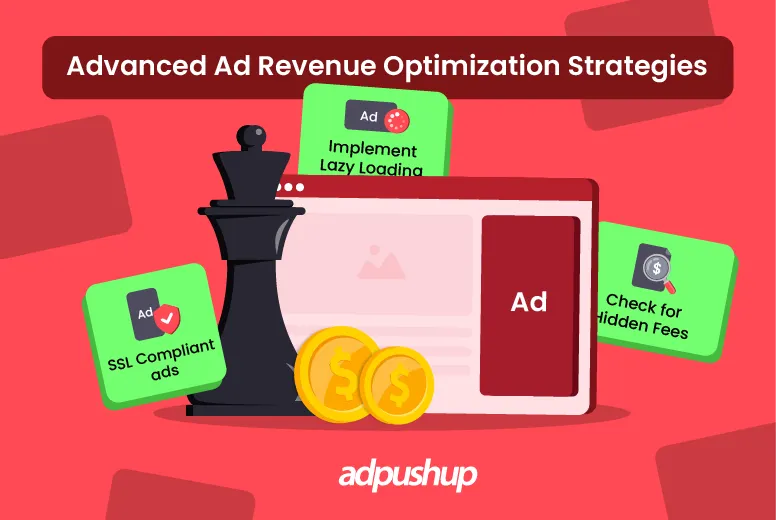
You have scoured every available playbook on ad revenue optimization strategies for publishers available over the internet and implemented every possible move. But still, the ad revenue flow is not in your favor.
To approach the granular aspects of ad revenue, you need to go beyond the ad and website basics and shift your focus towards the demand and supply paths. Adopting advanced ad revenue optimization strategies lets you do just that.
Our blog does just that. This blog explores what’s beyond the horizon – Bidder stack, SSL-compliance, RTB variables, and much more.
Key Takeaways: How to Increase Ad Revenue?
- Advanced ad revenue optimization for publishers involves analyzing the demand path and optimizing it to improve how buyers access and value your inventory.
- Granular level optimizations like Bidder stack optimization, operating system-level tunings and proper lazy loading implementation are best done by a seasoned AdOps team (like AdPushup’s).
- Publishers can further implement DPO-related strategies like removing duplicate supply paths, removing non-incremental SSPs, and implementing ad quality practices.
11 Advanced Ad Revenue Optimization Tips for Publishers
1. Bidder Stack Optimization
Bidder stack optimization refers to the processes that a publisher undertakes to remove the redundancies from its demand stack to make the bidding process more efficient. Generally, three factors are considered for bidder stack optimization:
- Optimal timeouts: It’s not an optimal practice to leave the bidding timeout at the status quo. Depending upon the number and the type of demand partners you have, it’s ideal to optimize the timeouts to minimize the ad request loads.
- Limited number of demand partners: Gone are the days when more demand partners meant more revenue. To avoid overloading the browser with ad requests, run quarterly audits to identify the demand partners who are not contributing towards your KPI completion and remove them as part of advanced ad revenue optimization strategies.
- Demand partners that are relevant to the niche: Displaying a stock management app’s ad on a recipe website won’t make the cut. So, it’s ideal to retain those demand partners that are relevant to your niche to maintain ad relevance and viewability, and reduce ad avoidance behavior like ad blocking.
2. Multiple Ad Requests
Partnering with multiple demand sources without considering the request load on the browser or server is a rookie mistake that even some seasoned publishers make.
According to IAB, an ad has 56 tracking scripts by the time it attempts to load on a webpage. To counter this, IAB suggests keeping the maximum number of requests to 15, a key factor in advanced ad revenue optimization strategies.
3. SSL-compliant Ads
If you think that serving SSL-compliant ads is a given, you may need to reconsider your stance. Not complying with SSL can leave your site data vulnerable to hackers and bring the website under the GDPR/CCPA radar.
As publishers, you should ensure that your demand partners are serving SSL-compliant ads. Even the ad networks and exchanges you are associated with should be serving SSL-compliant ads.
4. Implement Lazy Loading as per Audience Behaviour
To properly implement lazy loading, you first need to understand your audience’s behavior on various devices. Deploying lazy loading on above-the-fold placements only works when the user spends a few seconds on the first half of your webpage. To be exact, the time it takes for the ad to load on your website.
An effective technique is to begin evaluating lazy load levels based on actual user behavior. Load ads when they are 150 to 200 pixels from the view. Prioritize above-the-fold and early scroll zones. If necessary, employ device detection to differentiate thresholds between desktop and mobile users.
5. OS-based Ad Optimizations
Publishers with heavy incoming website traffic can’t miss this point. Apart from device and location-based optimizations, you also need to consider the operating system. Our AdOps team came across a publisher whose ads were being displayed differently on macOS and Windows. While the ads were running perfectly on macOS, the same ad units were misaligned on Windows.
As these are highly granular ad revenue optimizations, it’s always ideal to team up with an adtech partner or set up a dedicated AdOps team. Even if you haven’t noticed this issue before, analyzing your website traffic by operating system in Google Analytics 4 (GA4) can reveal important differences in how ads display across devices.
6. Check for Hidden Fees Charged by SSPs
Another challenge publishers face is the hidden fees by the SSPs. Since early 2017, many marketers have found undisclosed fees charged by the SSPs from both advertisers and publishers, which increased their margins and reduced yours.
While many have since removed these charges, it’s always a good practice to cross-check with your SSPs and hold them accountable for the charges they are deducting.
7. Remove Duplicate Supply Paths
Just like an advertiser works with multiple DSPs to get the best ad inventory at the lowest price, a publisher also works with many SSPs to bring in diverse demand and maximize their revenue.
However, a downside of this setup can be the duplication of the supply path, wherein the same inventory gets offered to the advertiser with varying attributes. This can lead to cross-bidding, which leads to advertisers competing against their own bid, and also limits the number of advertisers for you.
For this, publishers can maintain inventory uniformity across all SSPs. Even if you are to offer more inventory via a specific SSP, you can clearly add attributes to avoid cross-bidding.
8. Remove non-incremental SSPs
Having multiple SSPs can cause a variety of issues, including supply chain complexity, increased page load time (bad user experience), reporting challenges, multiple integrations, and supply path replication. Identifying and eliminating non-incremental partners can have a significant impact on your business and fix revenue leakages. By removing redundant SSPs, you can scale more effectively with partners who provide the best returns on your inventory.
9. Bird’s Eye View of the Data
Managing multiple supply partners means dealing with many reporting sources, each with different standards and definitions. Moreover, manually consolidating these reports can be time-consuming and complex.
By investing in a single automated tool that gathers all partner data into a unified format and generates clear visualizations, publishers can quickly gain actionable insights to drive demand optimization more effectively.
10. Ensure RTB Variables are Passed on Correctly
When publishers lean into Demand Path Optimization (DPO), they are not just fine-tuning their supply chain but making sure that critical RTB signals like User.ext.gdpr and User.ext.consent get passed along correctly.
Both of these variables are simple to use, but in some situations, your SSP and its DSP and agency partners may pass them incorrectly. If these variables are missing or poorly structured, buyers may default to not bidding.
11. Ad Quality Control
Ad quality control parameters are primarily set forth to ensure publishers brand safety and block inappropriate ads. Having a large number of partners can affect both the aforementioned factors.
While having multiple partners allows a publisher’s website to attract more demand sources, it also raises the risk of getting low-quality/fraudulent ads. By identifying and removing such partners, publishers can maintain the quality of their ad inventory without impacting the user experience.
FAQs on Advanced Ad Revenue Optimization Strategies
It means going beyond surface-level tactics (like adding more ad units) and optimizing deeper levers such as bidder stack efficiency, RTB signal accuracy, supply-path quality, latency control, and demand partner performance.
Yes. Non-SSL creatives expose your site to security risks and compliance issues (GDPR/CCPA). Publishers should routinely verify that every demand partner is serving HTTPS-secure creatives.
Some SSPs may charge undisclosed fees that can reduce publisher earnings. Cross-check your contract, compare net vs. gross revenue, and request transparent fee disclosures from all partners.
Most advanced optimizations require seasoned AdOps expertise, access to partner-level insights, and technical tuning across systems. It’s doable but far more efficient with a partner like AdPushup.
It is so because more partners = more requests, more latency, more duplication, and not necessarily more demand. Modern optimization is about fewer, high-value partners, and not volume. Non-incremental partners now actively drag revenue down.
Monetize With AdPushup
If your monthly ad revenue has already crossed $10K, it’s time to step up your optimization game. Join 500+ publishers who already trust AdPushup to maximize their ad revenue.
As a reliable Google-certified Publishing Partner, we have consistently delivered up to 40% higher eCPMs and faster yield growth through advanced header bidding and premium demand access.
Integration takes less than 30 minutes. Choose from code-based or plug-and-play setups, backed by a dedicated AdOps team.
Turn every impression into higher revenue with AdPushup. Contact us now!