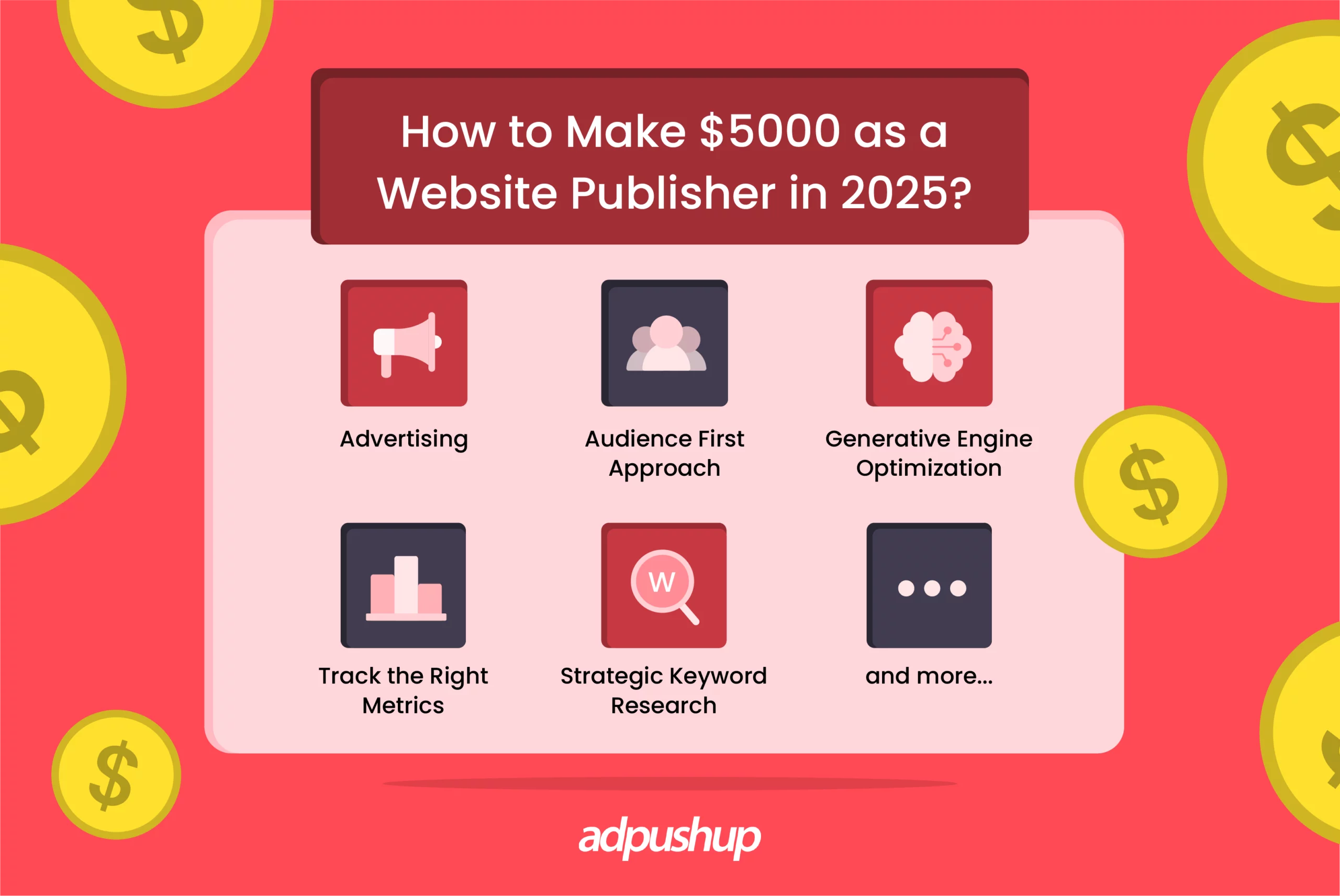
If you are looking for answers to the question “How to make $5000 as a publisher in 2026?”, you are at the right place. Read our blog to gain value-driven insights on innovative strategies that will help you earn your first $5000.
The competition in the publishing industry is ever-increasing, and with that dangles a sword over your survival. Even if you have yet to start your publishing business, having monetization plans beforehand is sure to keep you ahead in the race. However, minting money through websites is not a cake walk. It requires a well-thought and elaborate strategy with regular optimizations, along with caveats for Google’s updates and evolving technologies.
In this blog, we will be exploring a burning question among publishers: How to make $5000 as a publisher in 2026?
We will touch upon various website monetization strategies that you, as a publisher, can employ to earn your first $5000 from your publishing business.
9 Website Monetization Strategies to Make $5000 in 2026
1. Audience-first Approach with Intent-based Content
First things first. The most important step towards earning your first $5000 is understanding and identifying your audience, and creating content around their query’s intent. Now, intent-based content can either be short- or long-form, but, at the end, it should fulfil the intent behind the user’s query.
For instance, if you are catering to a B2B SaaS audience, your content strategy should consist of guides and deep-search content as the intent, in general, is information-gathering and decision-making. However, content strategy for B2C or DTC audience will include price or product comparisons, reviews, or listicles. Why? Because this audience is generally looking for quick, purchase-oriented information who value genuine reviews.
Quick Quiz: Audience-first Approach
Q: What type of content is most effective for a B2B SaaS audience?
2. Strategic Keyword + Prompt Research
If you thought you would earn your first $5000 just by creating deep, intent-based, and audience-first content, then you are in for a rude shock. While we agree that this content approach is advantageous, a content piece with no strong foundation will mean nothing to the user – and the search engine.
What we mean by a strong foundation is strategic keyword research. In this area, each publisher has their own experience. While some chase high-volume keywords, others focus on low-volume keywords with high intent. For instance, there will be keywords within your niche that won’t have much search volume or traffic potential, but are highly relevant to your niche. Use them!
However, with AI rapidly pacing within the publishing business, a new form of keyword research has come up – Prompt Research. It is an evolving technique where you find suitable prompts relevant to your topic using LLMs to increase your content’s visibility on AI chatbots.
There are quite a few ways to approach prompt research. First, you can feed your topic or keywords to the LLM and ask them to suggest the most appropriate queries related to them. Or, you can conduct a competitor research using the LLM, and then ask for most-asked queries related to the topic.
Another one: Perplexity AI, just like Google Search, shows related questions/queries at the end of the output. You can utilize those queries as well to rank on LLMs.
Quick Quiz: Strategic Keyword + Prompt Research
Q: Which keyword strategy is more effective for publishers aiming for sustainable traffic growth in 2026?
3. Track the Right Metrics
While figuring out How to earn $5000 monthly from a website, publishers tend to overlook one essential component in their monetization journey: comprehending their Website Metrics.
Yes, we know that as a publisher, you are constantly checking your website metrics. But are you sure you truly understand what those metrics mean? For example, Session Duration and Time-on-Site convey varied engagement patterns of your users. The former captures the overall length of the visit, while the latter indicates how long the user spends on a specific page.
You should also keep an eye on the scroll depth as this metric complements time-on-site. Higher time-on-site and scroll depth mean that those specific pages are driving the requisite results.
On top of it, you can gauge the value proposition and popularity of your website by tracking returning user sessions and new user sessions, respectively.
Meanwhile, bounce rate is another metric that you should measure. More importantly, you should know its benchmarks. A bounce rate between 30-50% is considered to be good for websites. On the contrary, a bounce rate near 20% can at times indicate bot traffic, which can deter advertisers or sponsors from associating with you.
Most importantly: the GA4 graph and the Search Console graph. We know that you know how to study the graph. But you ought to know the significance behind the two graphs as well. GA4 graph tracks your website traffic, while the Console graph tracks website clicks. The latter is also called a website’s health line, as it determines whether the website is going in the right direction or not.
Let us explain: Your website may have a good traffic flow, but if it’s not converting into clicks, you know that something is not going right.
As you can see in the above image, your console graph should always show an upward trend for positive outcomes for your website.
Quick Quiz: Strategic Keyword + Prompt Research
Q: Which keyword strategy is more effective for publishers aiming for sustainable traffic growth in 2026?
4. Subscriptions and Paywalls
One of the answers to the question “How to make $5000 as a publisher in 2026?” for many publishers is subscriptions. And there are good reasons for their preference. Firstly, you get a concurrent source of revenue. Secondly, paid users will automatically be loyal to your publishing business. Lastly, your users’ browsing experience will be ad-free.
This revenue model works well for premium publishers whose published content stands out as unique in the eyes of users. Here are some examples:
As you can see, publishers have tailored their subscription models to make it convenient for their users. Some offer absolute subscriptions where you have to pay to access the content. On the other hand, some have opted for metered subscriptions where they offer a few articles for free and then ask the user to subscribe.
However, it’s not the case with every publisher. Small or mid-scale publishers can find it difficult to build readership if they restrict their content via paywalls. To mitigate this conundrum, many publishers combine subscription models with advertising. We will cover this in more detail in the next section.
Quick Quiz: Subscriptions and Paywalls
Q: Which type of publisher benefits the most from a subscription/paywall model?
5. Advertising
Advertising is one of the most common ways publishers monetize their websites. It’s a proven method for earning revenue from website traffic, even if you’re not directly selling products or services.
As you can see, websites like Buzzfeed and Forbes utilize advertising to supplement their website revenue.
There are various ad formats and placements that you can employ, depending on your audience behavior, to start minting money. Taking reference from the above images, Buzzfeed has deployed a leaderboard for above-the-fold placement. This placement is in high demand among advertisers and typically attracts premium ads, resulting in better experience and higher revenue potential. The website has also deployed a wide skyscraper that offers heightened ad viewability and exposure.
On the other hand, Forbes utilizes full-screen video interstitial ads to attract their users’ attention. Due to its prominent presence, the ad format commands a higher eCPM compared to others.
There are many adtech vendors you can partner with to start advertising on your website.
AdPushup, a Google-certified Publishing Partner, is one of them. We offer innovative ad formats that are designed to increase ad visibility and eCPMs without sacrificing user experience. While running programmatic ads, you can also add header bidding to your stack. Our header bidding solution guarantees a 30-40% uplift in ad revenue with smart auction handling and advanced mediation logic.
You can read our blogs on programmatic advertising to get an in-depth understanding.
Quick Quiz: Advertising
Q: Which ad placement typically delivers the highest visibility and premium eCPMs for publishers?
6. Sponsored Content
Apart from ads and subscriptions, many reputed publishers also indulge in sponsorship content. It acts as a more refined and organic form of promotion that utilizes publisher’s existing content to promote an advertiser’s services.
Below is a very good example of sponsored content. The Saudi Tourism Board had collaborated with EuroNews to promote the Kingdom as an upcoming tourist destination.
Quick Quiz: Sponsored Content
Q: What makes sponsored content effective for publishers?
7. Affiliate Influencer Marketing
Quite unheard of, but influencer marketing is another strategy that service or product-based websites can adopt to earn their first $5000. To explain this further, we will be taking the example of Events Ticket Center (ETC). A BBB (Better Business Bureau) certified website, it is a ticket resale marketplace. In simple words, it connects buyers with people who are looking to sell an event ticket they already own.
Jesse Morgan, Affiliate Marketing Manager at Events Ticket Center, gave us some insights on our topic in discussion.
According to Jesse, one can start exploring influencer marketing even with a handful of followers rather than waiting to develop a large audience. In her case, she leveraged user-generated content to amplify the website’s reach.
Eventgoers shared their experiences at venues, and with their permission, that content was featured on the company’s social channels. This approach turned early users into natural brand storytellers, amplifying reach and authenticity.
Affiliate influencer marketing is a low-cost strategy, as the primary expense here is the commission paid per conversion. Moreover, as the content creation is delegated to influencers and brand advocates, the internal team remains free to focus on other initiatives.
To accelerate this process, Jesse recommends creating a comprehensive customer journey plan for existing members to turn them into loyal helpers. This includes personalized rewards, personal coaching, and loyalty incentives specific to the individual.
According to Jesse:
“Focus on building a community of brand advocates as soon as you have an audience in the double-digit range. Focus on the quality of those existing followers, and let these influencers focus on the quantity by bringing in new members.
If you stick with this method, it’s very doable to make your first $5,000 within a year or two. It won’t happen overnight, but the longer you persist, the greater the chances of hitting that $5,000 threshold.”
Quick Quiz: Advertising
Q: Which ad placement usually generates higher revenue and visibility for publishers?
8. SEO – Search Everywhere Optimization
SEO – the simplest and most cost-effective answer to your questions, like:
“What is the easiest way to make money with a content site this year?”
“How to make money from a website in 2026?”
“How to make $5000 as a publisher in 2026?”
However, in today’s times, SEO comes with a twist. It’s no longer search engine optimization; it has evolved to search everywhere optimization.
With publisher traffic taking a strong hit with AI, search everywhere optimization assists publishers in diversifying their traffic sources.
You know the basics of search engine optimization – keyword research, building topical authority with blog/articles , 3-6 posts a week on your website, and you are good to go (Inputs by Beatus Hoang, Sr. Growth Manager @ Exploding Topics).
But this isn’t the case in the SEO we are talking about. Search everywhere optimization considers each business PR dimension a traffic source: Forums, social media, YouTube, Google News and Discover, among others.
For example, DoorDash can be a great traffic source for restaurants with their own websites if used strategically. Their commission-free Online Ordering integration can drive direct orders, hence increasing website traffic in the long-run.
Google Discover is another platform that you can optimize to increase your website traffic. Discover is a platform that acts as a leveling ground for publishers. Why? Because Discover will only display your content if it matches with the user’s interests. So, no DA/DR, backlinking, or traffic wave will help you – only well-written, intent-matching content.
Quick Quiz: Affiliate Influencer Marketing
Q: What is one major advantage of using affiliate influencer marketing for publishers?
9. Answer Engine/AI/Generative Engine Optimization
According to a Digiday article, there has been a spike in LLM traffic going towards publishers’ websites. It doesn’t end here: the traffic has almost doubled in 2025. ChatGPT alone has sent 243.8 million visits to 250 news and media websites in April 2025, up 98% from 123.2 million visits this January.
With increasing usage of AI chatbots like Perplexity AI and ChatGPT Search for search among the masses, it’s a clear indication for publishers – start optimizing content for LLM traffic.
Even you can join the bandwagon by making some simple tweaks to your content strategy.
Firstly, keep your SEO game strong. A comprehensive AI mode comparison study by Semrush revealed a strong correlation between large language model (LLM) responses and the top 10 Google search results for any given query. In simple words, LLMs rely on the top 10 search results to generate answers for a particular query. This clearly shows that SEO is not dead. Rather, GEO (Generative Engine Optimization) is a part of SEO.
Here’s the rest of the checklist you should follow to optimize your website for AI chatbots:
- Use heading tags (H1, H2, and H3) to create a proper structure for your content. Make sure that the headings specify what the content below them will be about.
- Write key information using bullet points or numbered lists to simplify your content for AI bots to go through.
- Make important content visible in the source code (HTML). You can check this using the Ctrl+U command.
- The page load time should be under 3 seconds.
- Add clear, intent-driven anchor text for links.
- Use special codes for important content: FAQ markup for important questions, product markup for product pages, article markup for blog posts, and organization markup for about pages.
- Make core content load without JavaScript.
- Ensure that the interactive features do not hide necessary information.
- Enable server-side rendering for dynamic content.
Moreover, you can now track LLM traffic on GA4 and other web/app analytics platforms. Below is a graph tracking the LLM traffic on LookrStudio. You can read more about tracking LLM traffic here – How to track ChatGPT Traffic?. Our blog holds in-depth insights about LLM traffic that will help you optimize the AI traffic coming to your website.
Quick Quiz: SEO – Search Everywhere Optimization
Q: In 2026, what does “Search Everywhere Optimization” mean for publishers?
Bonus tips:
- Follow the inverted pyramid approach while writing content by starting with the answer. Moreover, make your sentences complete, concise, and self-contained.
- Optimize for intent-driven and question-based queries (What, Why, How, Who, X vs Y).
- Frame your content in a way that reflects a topic’s keyword ecosystem. For example, if you are writing on “SEO” (main entity), then do address or include the semantic keywords (related entities), like content optimization, crawlability, backlinks, search engine, and technical performance, among others.
- Mention summaries within the headings to make your content more extractable for the LLMs.
- Bold the important keywords to emphasize them.
- Replace dense texts with concise tables.
Key takeaways: With LLMs coming into the picture, the stakes have increased. Now, you will be writing not to rank, but to be quoted as well. Why? Because LLMs prefer fluff-free, polished content that demonstrates topical authority.
We have helped many publishers reach their first $5000 and way beyond that. Many either wanted to shift from AdSense, or simply wanted more granular optimizations to earn more from the same ad units. Compiling our observations, we are sharing some advanced ad monetization tips that you can deploy and reach your first $5000.
How to Assemble an Effective Ad Stack with the Right Partners?
1. More ads ≠ More Revenue
One misconception is that more ads equal more ad revenue. But what about the user experience hampered in this practice? To mitigate this risk, always follow the 60:40 ratio, i.e., the ads displayed should be 40% of the content you have on a webpage. This will help balance revenue and UI/UX.
2. Types of Ads
While banner ads can kick off your advertising revenue, you will require more advanced formats to scale it to reach $5000. You can explore more advanced ad formats & most commonly used ad sizes that offer higher eCPMs, like:
| Ad Type | Desktop Size | Mobile Size |
| Bottom Sticky Ads | 720×90 | 320×50 |
| Interstitial Ads | 336×280 | 320×480 |
| In-Article Ads | 640×360 | 320×180 |
| Side Rails / Side Bars | 160×600 | — |
| Flying Carpets | — | 336×600 |
3. Bidder Stack Optimization
Bidder stack is the next step after demand partner compilation. Having an array of demand partners, however premium, will only lead to a delay in ad serving. To circumvent this conundrum, you optimize your demand partner/bidder stack so that only the ones relevant to your website are bidding for the ad space.
In simple words, quantity ≠ quality. So, instead of having 40-50 demand partners bidding on your ad space simultaneously, simply optimize your demand stack so that only the relevant ones, or the ones whose bid will justify the placement, place their bids.
Moreover, you can even reduce the header bidding time from 3000 milliseconds to 2000 milliseconds if the demand partners are able to share their bid within this window.
And, yes, that’s exactly what we do.
P.S. – Did you know that bidder stack optimization is an Adtech green practice? It’s our way of giving back to the planet 🙂
4. Intuitive Dashboard
The dashboard logic is simple: the more reporting dimensions, the more granular the data. This same logic forms a major difference between Google AdSense and Google Ad Manager. If you are somewhere in between, it’s ideal to choose an ad partner that would provide you with more reporting dimensions compared to AdSense.
For example, in our dashboard, we have recently added ad viewability as a reporting metric. At the same time, we have also been providing publishers with bidder-level data since the beginning.
You can start earning your first $5000 via advertising by implementing the points mentioned above. In case you need a helping hand, fill out the form, get a free demo, and let the results drive your decision. Still in doubt? Check out how we delivered a 19.4% RPM increase to SonicHits within 44 days.
Key Takeaways: How to make $5000 as a Publisher in 2026?
1. There is no perfect answer to “How to make $5000 as a publisher in 2026?” as each publisher has different expectations and outlook on monetization. Rather than depending on a single strategy, it is advisable to create a hybrid website monetization strategy that includes different models working in tandem towards a common goal.
2. Core foundation strategies: Prioritize audience over traffic by creating intent-based content that solves that adds value. Target high-intent, low-competition keywords aligned with your niche. Continuously monitor relevant metrics like time-on-site, scroll depth, heatmaps, and bounce rate, among others.
3. Revenue diversification methods: Consider metered models for subscriptions and paywalls. Use premium placements for high-paying ads or ad sponsorships. Start affiliate influencer marketing by leveraging user-generated content to build brand advocacy.
4. Modern optimization techniques: Follow the organic SEO fundamentals to the nip. Optimize website and content for AI chatbots. Write complete, self-contained sentences using the inverted pyramid strategy to make your text quotable for AI bots.
5. Advanced ad revenue optimization tips: Maintain the 60:40 content to ad ratio for each webpage. Deploy advanced ad formats to increase your overall eCPM. Optimize your bidder stack to let only the relevant ones bid on your ad space. You can reduce the time-out duration in header bidding if the demand partners are able to share their bids within the new timeframe. Select a demand partner who provides a more intuitive dashboard compared to AdSense for granular-level data.
FAQs: How to make $5000 as a Publisher in 2026?
Organic SEO + GEO, sponsorships, creating content on transactional or commercial keywords, affiliate influencer marketing, and subscription models are the best ways to make money with a niche website.
Methods such as advertising, sponsored content, paywalls, email marketing, and AI optimization are some of the ways to monetize a blog in 2026.
Innovative ways to monetize website traffic include anonymized data monetization, memberships, selling digital products, and displaying high-paying innovative ad formats like interactive video ads.