
A concept long viewed as contentious, Amazon entering the open-source header bidding ecosystem, has now reached mainstream adoption. Once met with skepticism, the notion of Amazon collaborating through Prebid was often dismissed as impractical for large-scale publishers due to concerns about control and market consolidation.
Today, that paradigm has shifted. Amazon’s integration with Prebid is now recognized as a pivotal AdTech development, marking a turning point in the industry and introducing new avenues for publishers.
In this blog, we’ll break down everything on Amazon’s Prebid Adapter and how it simplifies demand availability & creates yield opportunities for publishers.
Key Takeaways on Amazon’s Prebid Adapter
- Amazon’s Prebid Adapter directly integrates Amazon DSP into Prebid, reducing complexity and latency.
- It boosts auction competition, driving 12–25% higher eCPMs on video and mobile inventory.
- Publishers gain complete control over pricing as Amazon’s built-in floors are discontinued.
- The adapter runs server-to-server on AWS for competitive bidding performance.
- Deployment requires managing the Prebid Server on AWS, but future-proofs publisher monetization.
Amazon Joins Prebid’s Open Source Movement
Amazon has recently launched its own prebid adapter. With the significant development, publishers can now include Amazon DSP into their prebid stack as a demand partner.
This development marks a significant change in the industry’s stance. Plus, with a big player like Amazon joining the Prebid movement, the open-source solution has found itself a supporter in the E-commerce giant.
Amazon’s Prebid Adapter: Why Does it Matter?
It matters for a lot of good reasons. Let’s break it down.
In the pre-Amazon Prebid Adapter era, publishers wanting to tap into Amazon’s demand had to rely on proprietary setups like Transparent Ad Marketplace (TAM) or Unified Ad Marketplace (UAM). This meant more integrations (often complex), which would add latency to the setup.
But Amazon’s Prebid adapter changes this.
Amazon Publisher Services has made it easy for publishers to connect Amazon’s ads to their websites using Prebid. Their new tool (server-to-server integration) lets Amazon’s display, video, and audio ads compete with buyers in real-time along with the existing stack.
Running on AWS infrastructure, the adapter reduces latency and increases auction density, allowing Amazon’s DSP bids to compete head-to-head with other demand partners.
This setup bridges Amazon’s vast demand pool with publishers using Prebid’s header bidding while maintaining the flexibility and transparency the Prebid framework is known for.
Quick Recap:
Amazon’s Prebid Adapter integrates Amazon DSP directly into the Prebid header bidding wrapper, replacing complex setups like TAM/UAM. Running server-to-server on AWS, it lowers latency and boosts auction density. This lets Amazon compete fairly alongside other bidders, increasing publisher revenue and maintaining Prebid’s transparency and flexibility.
What are the Benefits of Amazon’s Prebid Adapter for Publishers?
1. Increased Competition and Auction Density
Amazon’s DSP bids directly within Prebid’s header bidding wrapper, letting Amazon compete head-to-head with other demand partners. This leads to higher auction density and eCPM gains. In competitive auctions, early adopters claim eCPM improvements of 12–25%, especially for mobile and video inventory.
2. Seamless Integration (No More TAM/UAM Complexity)
The server-to-server Prebid adapter eliminates separate layers like TAM or UAM, connecting Amazon DSP directly to the Prebid stack. This cuts down latency and complexity for publishers.
3. Lower Latency and AWS Reliability
As the adapter runs on AWS infrastructure, it facilitates faster bid responses and more coherent auction processes. This, in turn, improves the fill rates and user experience.
4. Publisher Control Over Pricing and Transparency
With the discontinuance of TAM and UAM, Amazon no longer has built-in floors. This requires publishers to use the centralized Prebid Price Floors Module instead. The move aligns with Prebid’s standard practice, where floor management is handled globally by a dedicated module in Prebid core, rather than within individual bidder adapters.
With this, publishers now gain direct control over minimum eCPMs and bid rules. This supplements transparency, as publishers can see exactly who is competing for inventory.
5. Securing a Scalable Future
As Prebid solidifies its role as an integral monetization player, integrating leading demand sources like Amazon DSP reinforces its long-term strength. Its open-source design streamlines header bidding across partners, supported by AWS’s scalable infrastructure and real-time analytics.
Quick Recap:
Amazon’s Prebid Adapter boosts publisher revenue by increasing auction competition and eCPMs by 12–25%. It simplifies integration by removing TAM/UAM layers, lowering latency via AWS, increasing pricing control and transparency, and supporting future-proof monetization.
4 Challenges with Amazon’s Prebid Adapter
1. Deployment Complexity
Implementing Amazon’s Prebid Adapter can involve setting up or managing the Prebid Server on AWS, which requires high technical expertise.
2. No More In-built Floors
With Amazon’s in-built floors removed, publishers will have to either add the floors manually or rely on a reliable floor engine to continue extracting value out of their inventory.
3. Continuous Configuration and Optimization
Publishers will have to configure the adapter parameters and auction rules, apart from floors, in the Prebid Server to maximize revenue. This requires continuous A/B testing and optimizations, which can drain a publisher’s resources.
4. Data Privacy Compliance
Managing the auction server and data in AWS means publishers must handle compliance with user privacy laws like GDPR and CCPA.
Quick Recap:
Amazon’s Prebid Adapter demands complex AWS setup, self floor management, ongoing optimization, and strict privacy compliance. This can make the implementation resource-intensive for publishers to maintain revenue efficiency.
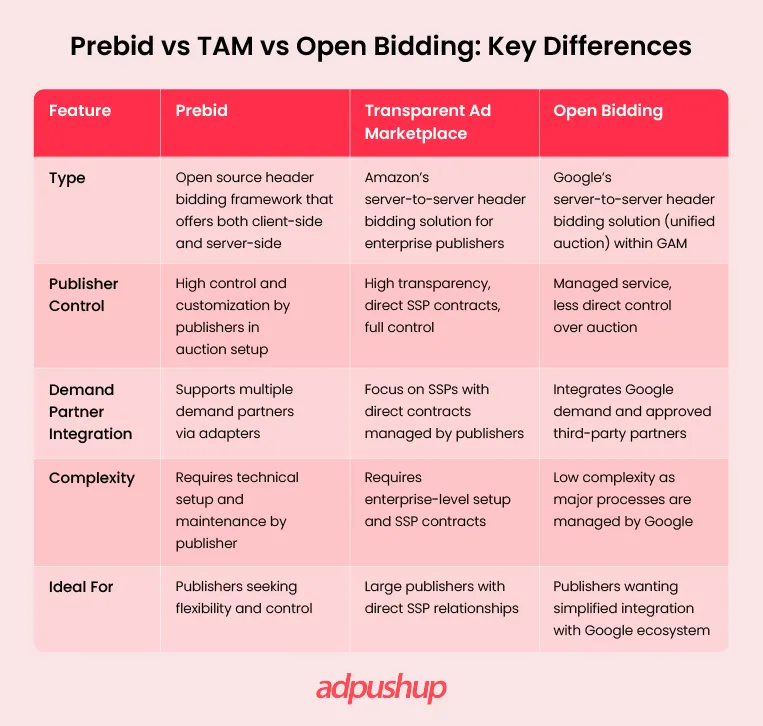
Prebid vs TAM vs Open Bidding: Key Differences
Quick Recap:
Prebid offers full control but higher complexity. On the other hand, Transparent Ad Marketplace facilitates transparent SSP deals for enterprise publishers, while Open Bidding simplifies setup with limited control under Google’s ecosystem.
Monetize with AdPushup
Maximize your ad revenue with AdPushup. Our premium demand partners, including industry giants like Media.net & Amazon, bring fierce competition to every auction, driving higher eCPMs and fill rates for your inventory.
With sophisticated AI optimization, real-time bidding, and advanced ad formats, we help you make consistent revenue growth while maintaining top user experience.
Partner with us to gain transparent control, expert support, and a scalable monetization solution designed for the modern publisher.
Get started today and see why leading publishers consistently report 30-40% revenue uplifts with AdPushup.
FAQs on Amazon’s Prebid Adapter
A Prebid adapter is a piece of code integrated into the Prebid header bidding wrapper that allows publishers to connect with a specific demand partner, such as an SSP, ad exchange, or ad network.
It is a line of code that adds Amazon DSP to prebid.js header bidding wrapper. This allows publishers to include Amazon as a demand partner in real-time auctions.