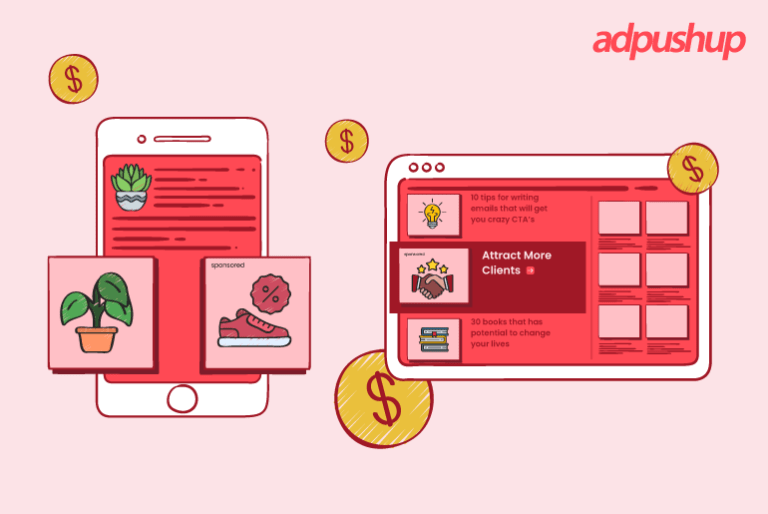

Users scroll past display ads, but they slow down for native ads. And numbers support this statement. Native mobile ads are known to deliver 20%–60% higher engagement and up to 8.8× higher CTR than traditional display ads, according to Business of Apps. With the global native ad market projected to reach $346.9B by 2033, the shift isn’t dictated by preference, but economics.
Now, add mobile native video ad formats, driving engagement by +180% to +530% to the mix. It becomes clear that publishers who master mobile native advertising are not chasing mere trends; they are capturing where attention, performance, and revenue now converge. These publishers are already making their publishing setup future-ready. And now it’s time you do it too.
In this blog, we will explore mobile native ads in depth, understanding their different formats, why they matter, and how publishers can extract maximum value from them.
Key Takeaways
- Mobile native ads are specifically designed for small screen environments (apps and websites) for advertising purposes.
- With CTR up to 8.8 times higher, mobile native ads outperform banners because they feel like part of the experience, not an interruption.
- Mobile native video formats increase engagement, and turn scroll behavior into measurable revenue lift.
- Publishers who adopt contextual, privacy-safe native formats are already future-proofing their monetization as cookies fade out.
- Native mobile ads deliver higher engagement and eCPMs when paired with an optimized AdTech stack.
What is Mobile Native Advertising?
Mobile native advertising is a format in which native advertising formats specifically designed for mobile environments are deployed for promotional purposes. Such formats are called mobile native ads and include both app- and web-native ads.
What are the Types of Mobile Native Ads?
According to MMA Global (Marketing + Media Alliance), there are eight mobile native advertising formats.
- In-feed Content Ads: Native ads designed to be displayed within editorial feeds or news apps.
- In-feed Commerce Ads: Native ads built explicitly for e-commerce websites/apps like Amazon and Etsy to promote products. These ads explicitly mention “branded” or “sponsored” to maintain authenticity.
- Recommendations Widgets: Ads that appear at the end of an article for suggesting related content/articles that users may find interesting.
- In-feed Social Ads: Native ads specifically curated to be displayed on various social media platforms like Instagram, Facebook, and X. They are also demarcated as ads for user clarity.
- Search Ads: Paid ads on mobile search result pages that match the surroundings of the organic search listings.
- In-game Ads: Opt-in video ads within games that players watch in exchange for rewards like in-game currency, while seamlessly blending with the game’s surroundings.
- In-map Ads: Location-based ads displayed within mobile map apps that look like organic listings and show details such as distance, navigation, hours, and click-to-call to drive foot traffic.
- Custom Native Ads: Brand-built, highly-tailored ad experiences that match a website/app’s surroundings to deliver immersive brand exposure.
What are the Benefits of Mobile Native Advertising?
1. Negates Ad Fatigue
Native mobile ads align with the website/app’s aesthetics and deliver genuinely relevant content to keep the users engaged. By integrating naturally into the user experience, they avoid the irritation and ad fatigue that plague intrusive pop-up formats.
2. Enhanced Purchase Intent
Mobile native ads sit naturally within app experiences, adding value without getting in the way. Their placement builds trust and interest, nudging users toward action. Since these ads feel helpful rather than intrusive, they spark stronger buying intent and often lead to repeat purchases.
3. Higher Click-through Rate
Mobile native ads blend into the app’s design, avoiding banner blindness and appearing like part of the content. Users often click them without realizing they are ads, even when marked as sponsored. This familiarity drives higher CTR and engagement than traditional banners, giving publishers better monetization opportunities and advertisers stronger performance.
4. Maintains the User Experience
Mobile native ads mirror an app’s design and behavior, making them feel like part of the experience rather than an interruption. They avoid clutter and do not push users away, unlike flashy banners or pop-ups. This seamless fit keeps engagement high and preserves a positive perception of both the platform and the brand.
5. Publishers
Native mobile ads are future-proof because they rely on contextual relevance rather than third-party cookies, which are being phased out. As privacy laws tighten and tracking options shrink, these ads continue to perform without needing user data.
This makes them a stable monetization model that protects publisher revenue and keeps advertisers invested in mobile environments that can still deliver measurable results.
Mobile Native Ads for Web vs App: Key Differences
| Feature | Mobile Native Ads for Web | Mobile Native Ads for Apps |
| Placement | Appears within website content streams | Blends into app UI and content feeds |
| Appearance | Styled like editorial elements or product listings | Matches app fonts, colors, and layout patterns |
| User Experience | Fits into reading or browsing flow | Fits into interactive app actions and screen transitions |
| Ad Formats | Sponsored articles, product widgets, content suggestions | In-feed posts, rewarded videos, app install units |
| Optimization | Typical web SEO cues and contextual matching | ASO-driven keywords and app store algorithm focus |
5 Best Practices to Implement Mobile Native Advertising
Native mobile ads, when deployed thoughtfully, can increase overall yield in the long term. Without disrupting the user experience, it can also increase your app/website’s engagement rate.
Here are some best practices for implementing native advertising on mobile.
1. Conduct Thorough A/B Tests
It goes without saying that you need to test the native mobile ads before the final deployment. As there are many types of mobile native ads, a thorough A/B testing will give you an idea as to which mobile native ads work best with your website/app’s interface.
Test for different placements and creative formats. Ensure that they don’t cover the whole screen while displaying. Also, take note of the quantity – you shouldn’t overwhelm the user with native mobile ads.
2. Partner with Native Ad Networks
Another point to consider is partnering with reliable ad networks. To be specific, reliable ad networks that specialize in mobile native advertising. Specialized networks offer expertise in native ad deployment and handle the nuances.
They ensure that native mobile ads match the overall UX of your website, that a clear demarcation is maintained between ads and sponsored content, and that you have control over placement and quality.
3. Transparency and Editorial Integrity
Native advertising blurs lines between content and advertising, so maintaining transparency is crucial. Clearly label the ads, maintain editorial standards, and ensure that only high-quality creatives are displayed in your mobile environment.
Poor disclosure erodes trust and may run afoul of regulations. For example, the UK’s Advertising watchdog had flagged Outbrain’s native links that didn’t clearly identify themselves as ads.
4. Ad Format Selection and Placement
Understand the available mobile native formats and choose the ones that make sense for your inventory and user behaviour. For mobile publishers, pick placements where users already engage (like scroll feeds & article lists) rather than intrusive overlays, so the native ad feels natural.
5. Align Ads with Content Flow
When deciding ad placements for mobile native ads, consider the visual harmony of your website or app. This includes the typography, layout, and spacing of your mobile environment. Planning around these considerations will ensure that your mobile ads truly become native, in line with the UX.
3 Emerging Mobile Native Advertising Trends
1. Mobile-first Strategies
Smartphone users worldwide will reach 5.12 billion by 2026, according to SQ Magazine. With mobiles accounting for 87% of native ad impressions, it’s quite natural for the industry to pivot towards mobile native advertising. Advertisers are already creating ads specifically for mobile devices, and the trend is only going to increase in the upcoming years. Mobile-specific native ad formats include vertical videos, mobile-optimized images, and highly tailored, experiential ads.
2. In-game Ads
The mobile gaming market is set to reach $232.58B by 2032. Moreover, there are 3.2 billion mobile gamers at present, and the number will reach 3.5 billion by 2025 end.
With a large, dedicated mobile audience, the industry is incorporating interactive and gamified content into mobile native ads to make them more experiential. It can include quizzes or gaming elements such as point scoring.
This is being done to increase user engagement and drive higher conversions, benefitting both publishers and advertisers.
3. Privacy-centric Mobile Native Advertising
With increasing data usage restrictions under CCPA and GDPR, the industry is aggressively integrating contextual targeting in mobile native ads. By making these ads privacy-centric, both advertisers and publishers are honoring user consent and maintaining their trust.
How an Advanced AdTech Stack Can Enhance Native Mobile Advertising?
Unlike what most publishers think, mobile native ads tank not because of a lack of demand, but because their stack is not engineered to extract the full value of the native formats. That’s where platforms like AdPushup step in.
1. Smarter Demand Access
AdPushup gives you access to 30+ ad networks and 50+ tier-1 ad exchanges (including Google AdX, OpenX, and Amazon), increasing competition for your mobile native ad inventory. When multiple premium buyers bid for your placements, CPMs climb and fill rates improve.
2. Better Yield Without Disrupting the UX
Most stacks chase incremental revenue by adding more ad slots. That’s where AdPushup changes the trajectory. We optimize existing placements to improve scroll behavior, fold dynamics, and latency. That means publishers can scale revenue without bloating the page or tanking the reading experience.
3. Ad Formats Built for Mobile Native Advertising
Rather than shoe-horning standard banners into native spaces, AdPushup supports dedicated native ad formats such as in-feed, in-article, and matched-content units. This results in ads that visually integrate with the content, reduce disruption, and deliver better engagement, increasing the yield.
4. Performance-centric Delivery
A strong ad stack addresses performance. AdPushup’s bundle-size reduction ensures that the ads do not affect the website’s core web vitals. Moreover, we prioritize minimized latency via lazy loading, CDN delivery and modular code generation.
When mobile native ads load quickly and don’t disrupt the user experience, viewability and session length improve, enhancing the website’s engagement rate.
5. Unified Reporting
AdPushup’s 360-degree reporting allows you to see which ad networks perform the best, at what times, and in what format. This means that your mobile native ad units can be iterated and placements tested to boost yield methodically.
If this addresses something you are looking for, sign up for a free demo!
FAQs on Native Mobile Advertising
Mobile native ads blend with the app or site environment, mimicking the look and feel of surrounding content, unlike display ads that appear as distinct promotional units.
Publishers ensure transparency by clearly labelling ads as sponsored, maintaining editorial integrity, and adhering to ad disclosure guidelines to avoid misleading users.
Yes, publishers can implement native ads across both mobile web environments and apps, using tailored ad formats optimized for each interface.