

Users don’t hate ads, they just hate bad ads. In today’s hyper-connected world, when ads start to interrupt users instead of ignoring them, users begin to block them. Globally, 42.7% of internet users use ad blockers because of intrusive ad formats that prioritize clicks over experience. To solve this problem, Better Ads Standards were introduced by “The Coalition for Better Ads” in early 2018.
Better Ads Standards came into the picture after researching 150000+ consumers across North America, Europe, Asia, and Latin America. These standard identifies disruptive ad formats and provide guidelines to create respectful, high-performing, and user-centric ad experiences.
Key Takeaways (Quick Summary)
- With 42.7% of global internet users relying on ad blockers, this resulted in a $22 billion loss in ad revenue for publishers worldwide in 2015.
- Google Better Ads Standards identified four disruptive desktop ad formats and eight mobile formats that users find most annoying. By avoiding these, publishers can reduce blocked ads, improve engagement, and protect their revenue.
- Publishers can use Google’s Ad Experience Report via Search Console to identify violations. By fixing these issues and getting certified by the Coalition, publishers can improve credibility with advertisers and the platform’s authority.
- Publishers must follow IAB’s video ad standards to ensure smooth playback and measurable performance. IAB defines three types of ad formats under these standards, namely: Linear Ads, Non-Linear Ads, and Companion Ads
- These standards offer a shared framework for delivering respectful, high-performing ad experiences. Ad networks can build better offerings based on whether the platform is in accordance with the Better Ads Standard or not.
What are Better Ads Standards Exactly?
Better Ads Standards is a framework created by the Coalition for Better Ads. The better ad standards aim at refining users’ experience with both desktop and mobile-based ads.
Google has identified 4 intrusive ad formats for desktop and 8 for mobile under the Better Ads Standards. Publishers are encouraged to avoid them as these ad formats are the least preferred by consumers, as they are likely to disrupt users’ browsing journey.
Better Ads Standards improve overall user experience and reduce the use of ad blockers. So on the good side, publishers are now aware of which ad types are the least preferred by users, thanks to the Google Better Ads Standards research. Eventually, the standards become valuable for publishers in their fight against ad blockers.
Intrusive Ad Formats: Desktop vs. Mobile
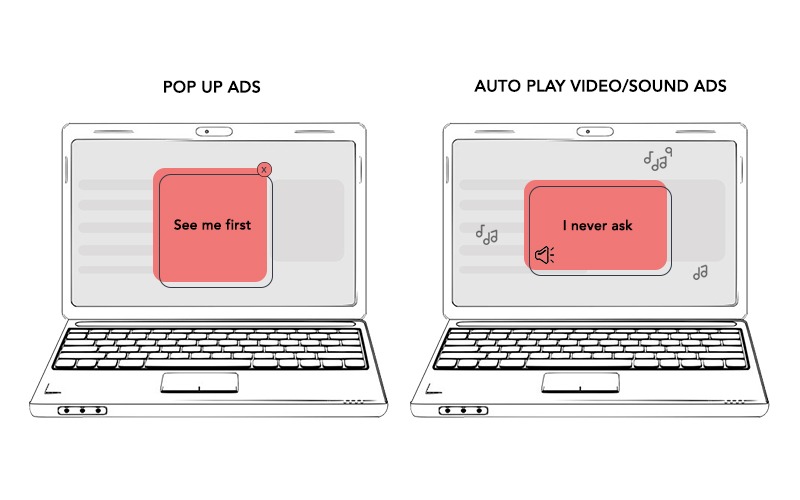
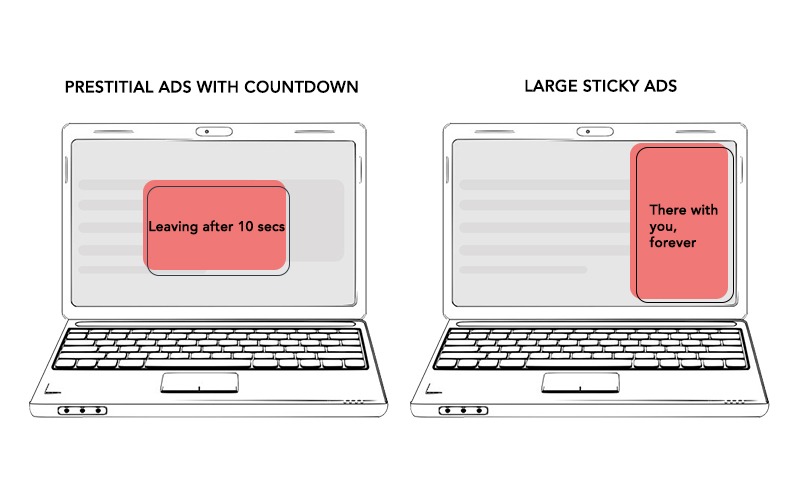
Desktop-based ads that were found to be the most disruptive:
- Pop-up ads
- Auto-playing videos with sound
- Prestitial ads with a countdown
- Large sticky ads
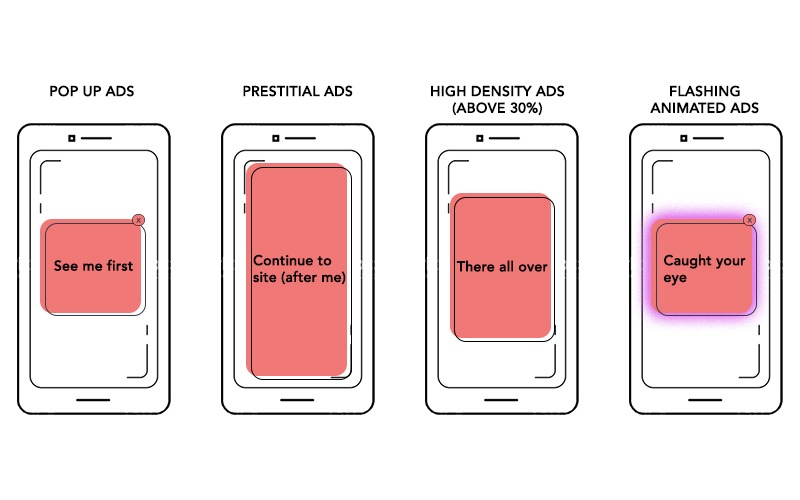
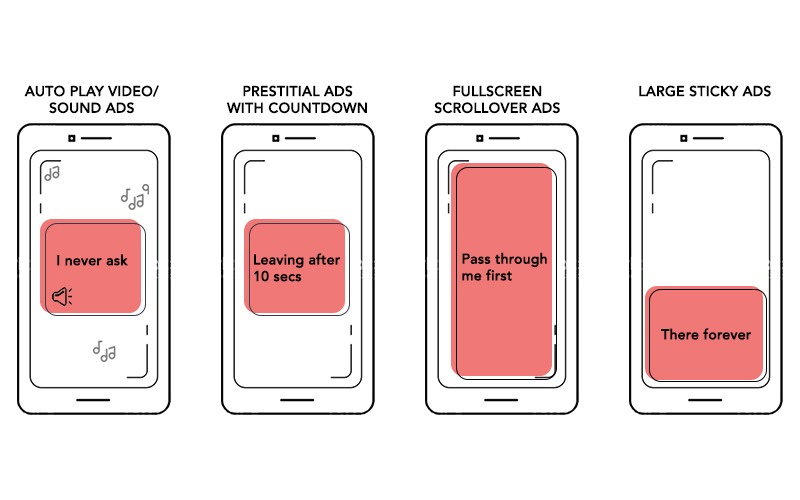
Mobile-based ads that were found to be the most disruptive:
- Pop-up ads
- Prestitial ads
- Mobile pages with more than 30% ad density
- Flashing animations
- Poststitial ads that require a countdown to dismiss
- Fullscreen scroll-over ads
- Large sticky ads
- Auto-playing videos with sound
Who Should Follow Better Ads Standards?
From its publication in 2017, the Better Ads Standards have been effective in North America and Europe, as stated above. In January 2019, the Coalition for Better Ads announced it plans to expand Better Ads Standards worldwide.
For Publishers
The standards guide them on how to follow best ad practices and deliver a better user experience to their audience. The coalition also runs a Better Ads Experience Program, inviting publishers to participate and get certification from Better Ads Standards for following the best practices.
For Advertisers
Better Ads Standards empower them to develop and execute informed ad campaigns. Since the standards target publishers in the first place, advertisers get a clearer idea of which publisher is compliant, which follows good practices, and with whom to work.
For Ad Tech Platforms
Ad networks and ad exchanges are responsible for helping publishers run ads on their websites. Better ad Standards help these platforms develop new and improved ad offerings for publishers, and hence users.
The coalition said that it will review the desktop- and mobile-based ad practices of publishers outside of North America and Europe.
How Publishers Can Comply with Better Ads Standards?
User experience is everything when it comes to advertising. If publishers overflow users’ browsing journey with pop-ups, autoplay videos, and screen-hogging banners, it will encourage the use of ad blockers and the loss of a good portion of ad revenue. Solution? Google Better Ads Standards.
This brings us to the next part of the article, how publishers can comply with better ad standards. Without further ado, let’s start:
- Start with self-reviewing Google’s ad experience report for your platform. You can access it via Google Search Console. It can brief you regarding the ad violations for both desktop and mobile platforms.
- Second, if you’re working with an ad partner, contact your ad ops team or check with the webmaster to fix the violations. After making the changes, you can resubmit your site for review.
- Go through Better Ads Standards to understand which ad formats users find annoying.
- You can also get certified by the Coalition for Better Ads. The certification will serve as a signal to advertisers that your platform meets the pre-defined standard and is user-friendly.
- A compliant platform improves authority and advertisers’ trust. At the same time, the publisher might see a reduction in blocked ads and better ad revenue.
How Does the Better Ads Standard Affect Publishers?
Publishers and ad blockers will always be in a loop of counter-adaption. Publishers have been losing a good chunk of their ad revenue due to ad blockers. In 2015, publishers lost an estimated $22 billion to ad-blocking software. By 2017, the number of ad blocker users had increased to 615 million.
This surge of ad blocker adoption was a loud signal that something is not right with the ad experience the user is having. Intrusive formats like pop-ups, autoplay videos, scrollovers, etc, are not just annoying, but also driving away the users and breaking the trust between the user and publisher.
That’s where Better Ads standards come in. Developed by a coalition of better ads, these standards identified the most intrusive ad formats and encouraged publishers to avoid using them to gain an advantage over ad blockers. By complying with Better Ads Standards, publishers can:
- Reduce blocked ads
- Improve user experience and engagement
- Improve their ad revenue
- Build trust with advertisers and the audience.
In short, Better Ads Standards are not just about enhancing user experience; they are also about helping publishers to protect and improve their ad revenue.
IAB’s Video Ad Standard
If we talk specifically about video ad format, delivering them across desktops and mobile is not as simple as pressing play. Publishers face a number of challenges, from inconsistent specs to technical video players, to deliver a seamless ad experience to the user. To bring order to the chaos, the Interactive Advertising Bureau (IAB) established some video ad standards to ensure that ads are not just optimized for delivery but are able to perform across every platform.
Through these standards, publishers get clear specs to work on ads that play smoothly. Secondly, ad servers can use these standards to keep track of performance metrics like impressions, CPM, bounce rates, and conversions.
IAB’s video ad standard defines three types of ad formats based on the type of ads publishers choose to place on their platform:
Linear ads define classic commercials like pre-roll, mid-roll, or post-roll ads. As the name suggests, these ads play before, during, or after content. They’re bold and interruptive, with durations of 6, 15, or 30 seconds and aspect ratios like 16:9 for HD screens.
Non-linear ads define subtle overlay ads, which appear during the content. They are interactive, clearly labelled, and designed to expand or redirect with any impressions.
Lastly, companion ads are like the supporting cast for the main content of the platform. These ads run alongside linear and non-linear ads.
FAQs on Better Ads Standards
The Better Ads Standards, developed by the Coalition for Better Ads, are a global benchmark for what constitutes acceptable online advertising. These standards are based on extensive consumer research across multiple regions and aim to remove or discontinue ad formats that frustrate users.
A better ad policy is one that aligns with both consumer expectations and platform guidelines. For example, Google’s Publisher Policies enforce the Better Ads Standards by penalizing sites that host disruptive ad experiences.
Leading media companies and ad industry trade associations formed the Coalition for Better Ads to develop standards to improve the ad experience globally. Among its members are Google, Facebook, Microsoft, News Corp, Group M, Admiral, and others.
Advertising standards are ethical and regulatory frameworks that govern how ads are created and distributed. Globally, organizations like the International Chamber of Commerce (ICC) and national bodies like ASCI in India set these standards