
When users watch rewarded video ads to unlock exclusive content, in return they receive a limited-time discount or earn loyalty points. Publishers get rewarded with ad revenue, making it a win-win situation for both the publisher and the user. Here is an overview of what rewarded video ads are, how publishers can use them to earn better revenue in 2025 and beyond.
Rewarded Video Ads have proven to be a game-changer for publishers seeking effective results. Users tend to skip ads faster than the blink of an eye, causing your ad campaigns to be ignored or skipped. Rewarded video ads have proven to be a great solution for publishers seeking an effective and user-friendly way to increase user engagement and retention. Whether you’re a web publisher or an app developer, leveraging rewarded video ads to earn revenue can be one of the best ways to earn ad revenue. Thanks to their proven track record of success, over 76% of mobile game players would rather choose rewarded video ads than watch ads.
Publishers are increasingly acknowledging the tremendous benefits of incorporating rewarded video ads into their monetization strategies. Particularly in the gaming industry, these ads have taken centre stage as the “hottest revenue generator” in the market. According to a recent survey conducted through Facebook Audience Network, it was clearly indicated that 32% of players find rewarded video ads useful, 27% find them interesting, and 12% think they are enjoyable, making rewarded ads the most likeable form of ads.
In this blog, we’ll discuss what are rewarded video ads, how much-rewarded video ads pay, and the best-rewarded video ad practices that can help you in 2025.
Rewarded Video Ads are a type of ad format that provides users with an option to choose a video in exchange for an in-app reward. Rewarded video ads are consent-driven, provide value to the user, and allow app developers to monetize their apps at the same time. Through rewarded video ads, users can watch ads in exchange for some incentives like an extended free trial, extra coins or goodies in the games, a puzzle hint, or access to some exclusive features or content.

For example, if users are playing a mobile game, they can be rewarded with in-app virtual currency for watching a full-screen ad for 15 to 30 seconds. These ads are non-skippable, but there’s usually an option to opt out of this type of advertising.
For example, if users are playing a mobile game, they can be rewarded with in-app virtual currency for watching a full-screen ad for 15 to 30 seconds. These ads are non-skippable, but there’s usually an option to opt out of this type of advertising.
Rewarded video ads are gaining momentum because they offer an honest value exchange – a user views an ad for a specific time duration and receives a premium gift.
Typically, people dislike in-app ads because they interrupt the user experience. However, when there is an exchange of value, the experience becomes less intrusive and more rewarding for the user.
In short, rewarded video ads are:
How does Rewarded Video Ads work?
Rewarded video ads act as an extension to the apps and games’ user experience. Their value-driven nature makes them a win-win strategy for both users and publishers. But what exactly goes behind the strategy of rewarded video ads? Let’s explore
The process consists of user interaction →need for reward →opt-in to watch → receive the reward.
Rewarded video ads are a three-step strategy that any publisher can use to monetise their content. These three steps include:
Step 1: Rewarded Video Ad Offer:
An in-app event triggers a pop-up of a video ad. The pop-up allows the app user to watch a video in exchange for a virtual gift.
Step 2: Watch the Ad:
The user can either dismiss the offer or watch the ad for a specific amount of time (5 seconds to 30 seconds) to get the reward.
Step 3: Earn the Reward:
Once the ad ends, the viewer gets the reward and continues using the app.
Do you know? AdPushup creates rewarded video ad popups that can boost engagement on your site! If you are looking to implement less intrusive or more appealing ads for your viewers. Contact Us. We’ve got you covered.
9 Best Rewarded Video Ads Practices
Now that you know how they work, let’s take a look at the best rewarded video ads practices.
1. Ensure Proper Ad Placement
Natural Integration: Showing ads to engage users without interrupting them is the main goal of rewarded video ads.
Trigger Timing: Users will see ads as a deal rather than an obligation when in need. Displaying ads when users are keen can be a perfect trigger for ads.
Best Practices: In games, players are most likely to watch an ad for a second chance.
2. User Experience Should be a Priority
Frequency: Overloading users with ads is a big no! You can set limits in terms of timing and frequency at which the ad is shown to the user.
Quality Content: The quality of ads is non-negotiable when it comes to displaying ads on any platform. Ads that match the vibe and style of the platforms are good to go.
Best Practices: Balanced ad frequency, good quality creatives and relevant ads will help to engage users without making them feel overwhelmed.
3. Meaningful Rewards for Users
Relevance: Rewards that match the purpose of users to watch the videos are a must when it comes to rewarded video ads. For example, getting extra in-game lives for a 30-second ad is an enticing deal.
Value: The value of the reward is what attracts a user towards a trade. Make sure that the reward is cool enough for users to want it and add value to their experience.
Best Practices: For games, getting gems, extra lives, or any power-up in exchange for an ad can keep users engaged and avoid ad fatigue.
4. A/B Test Different Rewards for Optimal Results

Relevance: A/B testing allows publishers to optimize rewarded video ads. By testing different versions of the ad creatives, such as ad type, video length, and CTA placement publisher can determine which creative drives the most engagement and retention from the user.
Best Practices: It is crucial to test different types of rewards or incentives that you can offer to your users. Testing helps developers learn which rewards are most loved and understand optimal offerings that can monetize their apps.
Value: A/B testing the rewards, including variants such as type of reward, duration of ads, quantity per session, and ad placements, can improve the effectiveness of your rewarded ads and maintain user satisfaction.
5. Using Rewarded Video Ads for In-App Purchases
Relevance: If you offer users a taste of premium experiences like special features or premium content through ads, it will build their interest in future purchases.
Value: Users spend 4 times more on in-app purchases after receiving the benefits through rewarded video ads. If you provide value to them now, they will likely convert in future.
Best Practices: Using this hybrid model, you can implement rewarded ads as a complement to in-app purchases, where rewarded ads will serve as an introduction to
Premium features.
6. Opt-In for Interest-Based Ads
Relevance: Showing interest-based ads is the key to maintaining trust among users. If ads are a part of the experience, users will feel more native and respected while seeing the advertisement.
Value: When users encounter something of their interest, they are more likely to engage and take meaningful actions like purchases or sign-ups.
Best Practices: Try to match categories of ads with user activity and app context, and continuously assess user interests to refresh ad types accordingly.
7. Smart Ad Mediation
Relevance: This practice involves ad networks that help publishers to maximise their yields by priortizing the highest paying ads. Even in the demand dips, this method keeps the revenue stable.
Value: Platforms like Google AdMob use “Ad Network Optimization” to serve the most valuable ads. It’s a great way to simplify monetization for publishers and increase average revenue per user.
Best Practices: Ad Mediation settings should be updated on a regular basis, you can monitor fill rates and eCPM trends to identify top performers, and you can also test new networks to diversify revenue sources.
8. Tryout Ingame Assistance As Rewards
Relevance: User retention is one of the most important metrics for ad success. Providing in-game tips not only improves user retention but also makes users feel more connected. By offering hints or tips as a reward, the assistance will feel earned, not forced.
Value: By strategically placing the help or hints user will not feel overwhelmed if stuck somewhere. This method is very effective in education apps, puzzle games, and productivity tools.
Best Practices: You can trigger hints based on user behaviour, like inactivity or repeated failure. Take consent, i.e. let users take a hint when they want to, not automatically.
9. Segment users for Better Ad Delivery
Relevance: Not every user wants the same thing. You can segment the audience to efficiently allocate rewards based on behaviour. For instance, you can encourage light users to return and incentivise loyal users.
Value: Tailored rewards can significantly increase ROI (Return-On-Investment) and user satisfaction.
Best Practices: You can use behavioural triggers like login frequency, spend history, etc, to define user groups. Avoid over-incentivising loyal customers as they are already invested.
Examples of Rewarded Video Ads
While these ads are most commonly used in gaming apps, their potential has been tapped into many other niches like retail, wellness, and education apps. We have found some real-life examples of rewarded video ads and how they have other placements and uses. Let’s have a look:
- Nosixfive JumpDrive, a space survival game, saw better monetization, more enthusiastic players and amazing reviews when they introduced rewarded video ads into the game. Through these ads, users were able to supercharge their progress. This made the user feel fair, earned, and more interested in the game and led to high eCPMs.
- Scared at first, Chinese app developer of Avid.ly thought that rewarded ads would crush the in-app purchases. But when integrated users were recorded to spend 20% more time in the game. Revenue saw a huge spike of 40% because the ads reflected “try-before-you-buy” experiences.
- CookApps is a global gaming company that has acquired more than 80 million gamers in North America and Europe. They used rewarded video ads to offer extra lives and placed triggers for the ads where users might need them. And then they saw an explosion in the session lengths of 211%.
The key is to serve the right in-app video (with attractive rewards) at the right time to generate the best results. Any kind of app can implement a reward system as long as there is a medium to reward the user. If you plan to implement these ads, make sure to know what your options are, what incentives you can offer, and how you can balance the revenue you generate through the ads.
Advantages of Using Rewarded Ads
Rewarded video ads hit three birds with one stone – users, advertisers, and developers/publishers:
I. For Users:
This type of ad is less intrusive for users because the viewers have an option to either dismiss or accept the reward offer. There is no autoplay, and the users are never forced to watch them. These ads offer the following benefits to the user:
1. Value Exchange
Since these ads are accompanied by incentives, users don’t mind spending a few seconds watching an ad. Furthermore, they are able to gain in-app premium features without spending money. Put simply, it’s a beneficial deal for users.
2. User Experience
According to Google, 50% of users say that they would be less satisfied with the app experience if rewarded video ads were removed.
II. For Advertisers:
1. Guaranteed Quality Engagement
Rewarded video ads have a higher ad viewability score as compared to other ads, because users are not rewarded unless they’ve viewed the ad completely. There’s also no option to skip ads, so it guarantees a higher completion rate of ad views.
2. Retention
Since these ads allow users to either opt-in or opt-out, it’s more likely that viewers are watching ads they have some interest in. In other words, such ads ensure better audience targeting.
III. For Publishers/Developers
1.Engagement
If you’re a publisher or developer aiming for higher user retention rates on your ads, you must consider rewarded video ads. Users are more likely to stay if they have the opportunity to earn rewards or get something interesting in exchange.
As much as 80% of the rewarded video ads target audience opt-in to view ads. The more users, more will be the revenue you will generate through your ad units.
2. Retention
Rewarded video ads are developers’ favourites because they keep users engaged and boost ad revenue. These formats are designed to protect the core app experience and efficiently monetise users who don’t want to make in-app purchases.
3. Revenue Generation
Finally, this type of ad provides a great opportunity for implementing a hybrid monetization model through in-app purchases. An increasing number of apps that monetize via in-app purchases are implementing rewarded video ads as a by-product of IAP.
That’s not all – rewarded video ads can also serve as an introduction to paid features of an app, so not only do users stay engaged, but some of them might eventually become paid customers over time.
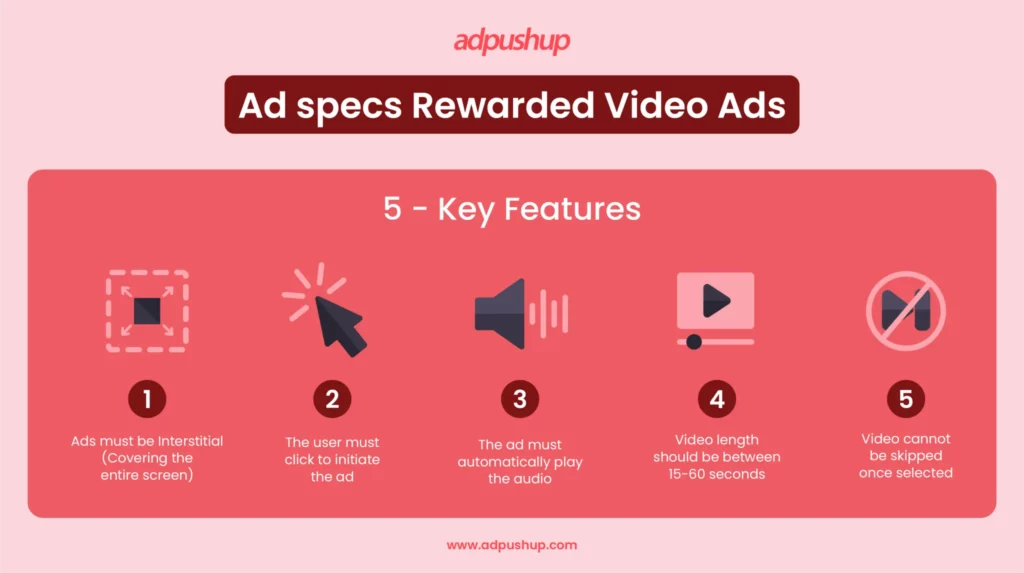
Ad Specs for Rewarded Ads
Specifications for these ads differ by ad platform. However, below are a few of the most-followed guidelines:
What are Rewarded Video Ad Networks?
Rewarded video ad networks are platforms that connect advertisers with publishers, offering a range of video ad formats where users can opt to watch ads in exchange for rewards or benefits.
These networks have gained popularity due to their effectiveness in engaging users, driving higher ad completion rates, and providing a win-win situation for both advertisers and users.
Some of the popular rewarded video ad networks for adding publishers or mobile game ads include:
Rewarded Video Ads Trends for 2025 and Beyond
Rewarded Video ads deliver value, not just visibility. As user engagement is one of the greatest virtues in programmatic advertising, rewarded video ads have been helping publishers aiming to enhance their ad revenue and user engagement. As a non-intrusive ad format, publishers are widely accepting and implementing it and seeing results. The following are some recent trends that underscore their impact:
- More than 50% of mobile users have reported longer session times due to reward incentives, indicating increased engagement.
- Being 2X more effective than traditional ad formats, rewarded video ads offer comparative effectiveness among other ad formats.
- Rewarded Video ads offer acquisition potential as 84% users reported that they are likely to try a new app or game if they include rewards.
- With 71% of users preferring to watch a rewarded video ad for in-app purchases, it’s clear that rewarded video ads are more than just an alternative.
- In terms of user satisfaction, 50% gamers reported reduced satisfaction when this feature was removed from their app experience.
- And the best one, Publishers have reported a 41% uplift in their ad revenue after integrating rewarded video ads.
So, what does it all mean?
Rewarded Video Ads are redefining user engagement and monetization opportunities for publishers and advertisers. They drive retention, satisfaction, and revenue through value-based experiences they provide to the user.
Now, let’s explore what the best practices are that you can adopt and make the most of rewarded video ads
Key Takeaways:
- Rewarded Video Ads are consent-driven short video ads that offer in-app purchases as a reward after viewing them. They are a famous ad format as they provide value exchange for users and monetization for publishers.
- They work as a three-step process: user interaction < need for reward < opt-in to watch < and receive the reward.
- These ads are known for significantly improving engagement (50% longer sessions), 2 times more effective than traditional ads, and can improve publisher revenue by 41% on average.
- Best Practices for Video Ads Include – Ad Placement, UX experience, A/B testing, hybrid model of rewarded ads and IAP, interest-based ads, and smart ad mediation.
- Real-life examples of rewarded video ads include – Nosixfive JumpDrive, Avid.ly, and CookApps, which rightfully demonstrate how strategically placed rewarded video ads can lead to increased engagement, longer sessions, and a significant increase in revenue.
- Platforms connecting advertisers and publishers for rewarded video ads, facilitating user-opted views for in-app benefits. Popular networks include AdColony, Unity Ads, Chartboost, Litoff, and AppLovin MAX.
FAQs: Rewarded Video Ads
As the name suggests, this ad allows users to watch a video or interact with a playable ad in exchange for a reward. As an example, mobile game players will eventually “die” upon reaching a critical point.
Rewarded video ads typically last between 15-30 seconds. These ads allow viewers to earn prizes, benefits, and bonuses just by watching them.
A Successful Ad Must Have These Five Elements-
i. The target audience should be clearly defined
ii. The value proposition
iii. Content and design of high quality
iv. Call-to-Action (CTA)
v. Follow-up
The main advanatgs of these rewarded ads is that it helps your users to watch a video and win a reward within the app or engage with a playable ad.
These ads offer the highest eCPM rate. So you can expect eCPM rates to be $15 to $55 per 1,000 impressions.