
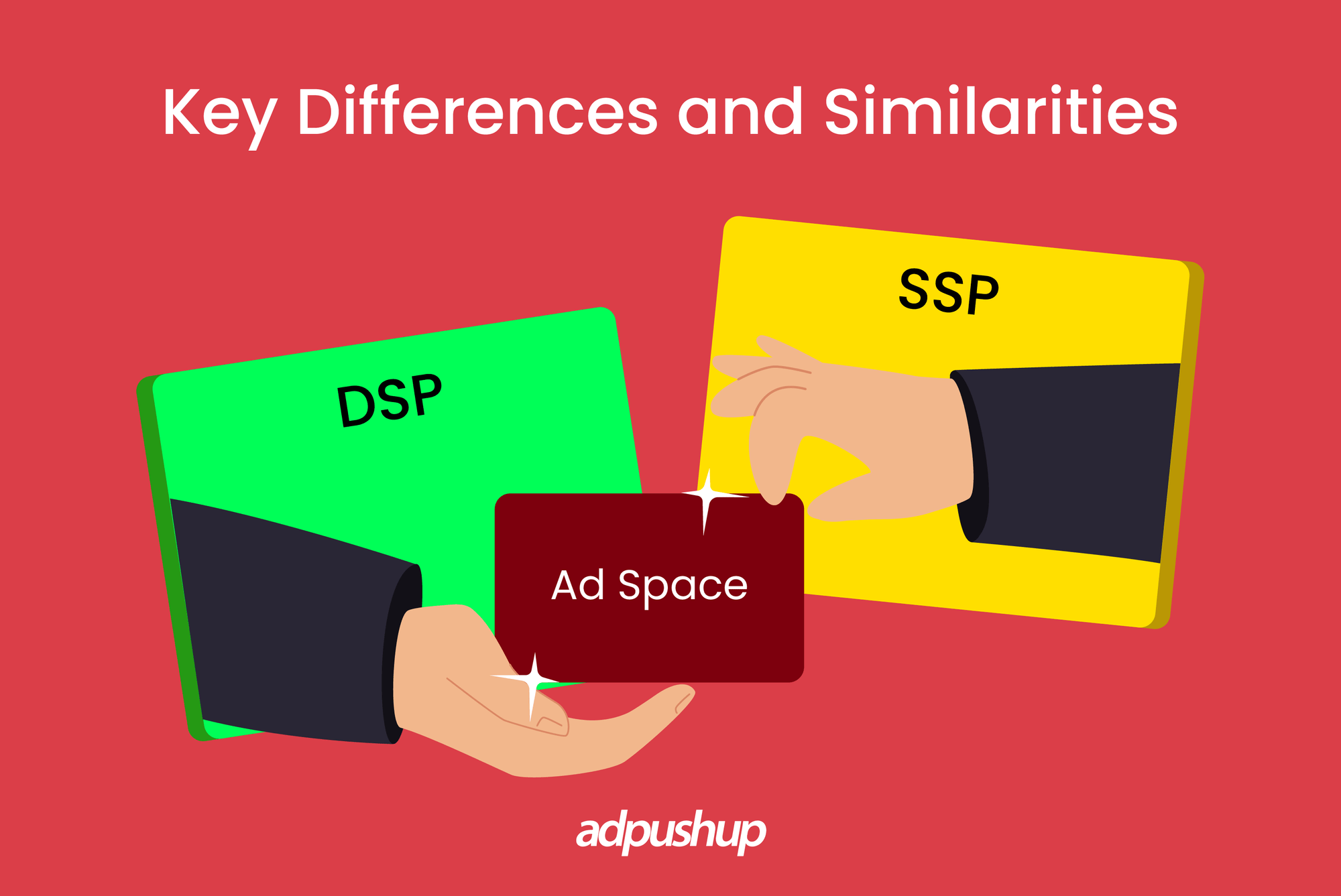
In programmatic advertising, DSP (Demand-Side Platform) enables advertisers to buy ad inventory, while SSP (Supply-Side Platform) allows them to sell their ad inventory. In this DSP vs SSP guide, we’ll discuss how each platform functions, their unique advantages, as well as their correlation between DMPs, Ad Exchanges, and more.
As we step into the world of programmatic advertising, we come across plenty of jargon that can be quite difficult to understand. At the heart of this complex ad tech ecosystem lies DSP and SSP. These two key players are often shrouded in mystery.
Apart from DSP and SSP, another of the most prominent and regularly occurring terms in ad tech is DMP (Data Management Platform). They all work as efficient tools and are used by advertisers and publishers to optimize their gains in a bustling marketplace.
So, if you are perplexed over what is DSP, what is SSP, how they differ, and what role a DMP plays, this blog is just what you need. So, without further ado, let’s get started.
What is a DSP (Demand Side Platform)?
So, what does DSP stand for? DSP refers to the Demand Side Platform, a technology that allows advertisers to purchase ad space from various publishers and ad exchanges through real-time bidding.
The term “Demand” in Demand Side Platforms refers to the advertisers and agencies seeking to buy publishers’ ad inventory to promote their products/services online. DSPs use automation throughout the whole process to buy ad impressions for advertisers at the most competitive prices possible through ad exchanges ( a marketplace where advertisers and publishers can buy and sell ad inventories). Automation allows advertisers to reach their target audience and optimize their ad campaigns using data and analytics provided by DSPs.
Quick Quiz: What is a DSP?
Q: Which option best describes a DSP?
How Does DSP Work?
Understanding how a Demand-Side Platform (DSP) works is essential to get hold of the intricacies of programmatic advertising. So, basically, it consists of five steps mentioned below:
- Step 1: The user will visit your website.
- Step 2: The information about this user is stored in a DMP (Data Management Platform), which is connected to the DSP and sends the data to the ad exchange.
- Step 3: It uses the user data based on demographics, behaviour, location, and device type and comes up with the most valuable ad impressions for the advertiser.
- Step 4: The DSP participates in an auction to bid on the available ad space in real-time, based on the advertiser’s targeting criteria and budget.
- Step 5: The highest bid wins the ad placement, and then, finally, the ad is served and shown to the users.
Demand Side Platform Examples
When it comes to a list of the best DSPs in the ad tech industry, companies like Google Display & Video 360, MediaMath, and Adobe Advertising there Cloud will always find a spot. These renowned platforms make for a great example of a demand-side platform. However, there are a lot more DSPs out offering different features and functionalities.
Some of these platforms combine DSP and SSP, and some even integrate DMP (Demand Side Platform) with these two platforms to maintain efficiency and transparency for advertisers to manage their advertising operations.
Now that we are well-versed in demand-side platforms, let’s delve deeper into DSP vs. SSP and discuss the SSP’s meaning in advertising and how it helps publishers.
What is SSP (Supply Side Platform)?
SSP, or a Supply Side Platform is a technology used by publishers to manage, sell, and optimize ad inventory. In fact, according to Statista, a survey carried out on US publishers found that the publishers, on average, use around 5 SSPs together to enhance their ad revenue.
The term “Supply” in Supply Side Platforms refers to the websites and apps that offer their ad spaces to advertisers.
SSPs connect publishers with various ad exchanges, DSPs, and ad networks simultaneously. This allows publishers to serve a large set of buyers and boosts revenue effectively.
Moreover, supply-side platforms are becoming more and more popular among publishers.
The global supply-side platforms market is experiencing rapid growth, with projections indicating a Compound Annual Growth Rate (CAGR) of 20.20% from 2023 to 2028.
Quick Quiz: What is an SSP?
Q: The primary role of an SSP is to:
How Does SSP (Supply Side Platforms) Work?
To understand the process, you can go through the following steps:
- Step 1: A publisher integrates their app or website with SSP to manage and categorize ad spaces.
- Step 2: When the user visits the publisher’s site or opens the app, an ad request is sent to the SSP, which contains all relevant information (demographics, behavior, and browsing history).
- Step 3: The SSP sends the ad request to multiple ad exchanges and DSPs.
- Step 4: The user data is analyzed by the DSPs, and a bid is placed in the available ad space in real-time.
- Step 5: The SSP selects the highest bid from the auction and places the winning ad on the publisher’s site or app.
- Step 6: The winning ad is delivered to the user in real-time.
Apart from this, the SSPs also provide detailed reports and analytics to the publisher that help them optimize their inventory and pricing strategies for future ad placements.
Supply Side Platform Examples
Some of the most common examples of SSP we can provide include platforms like Google Ad Manager, OpenX, Magnite, and PubMatic. Google Ad Manager stands out as the most popular SSP as it integrates with Google’s ad ecosystem and provides publishers with the required tools to manage ad inventory and optimize revenue. Much like DSPs, there are a lot more examples of DSPs or platforms of DSPs, each designed to meet the specific needs of publishers.
Understanding the Difference Between DSP and SSP
Is DSP and SSP same? Let’s find out,
Simply put, DSP (Demand-Side Platform) caters to advertisers who want to buy ad spaces from web publishers’ inventory. The term “Demand” in Demand Side Platforms refers to the advertisers and agencies seeking to buy publishers’ ad inventory to promote their products/services online.
On the other hand, SSP (Supply-Side Platform) caters to publishers who want to sell their ad inventory. The term “Supply” in Supply Side Platforms refers to the websites and apps that offer their ad spaces to advertisers.
Now that we know which platform serves which side—advertisers for DSPs and publishers for SSPs—it’s important to note that there are many more differences between them.
Quick Quiz: DSP vs SSP (Who Uses What?)
Q: Match the platforms to their users:
Critical Differences Between SSP and DSP (DSP vs SSP)
If we look at the broader picture, demand-side platforms help advertisers buy ad space efficiently, while supply-side platforms help publishers sell their ad space at the best price. But there’s a lot more to it, so let’s look closer at DSP vs SSP stand-off.
User Base
First of all, there’s a clear difference in end users. Marketers and advertisers use DSPs to get the most out of their ad campaigns. Meanwhile, SSPs are used by publishers who want to sell ad space to advertisers at the best possible price.
Primary Focus
The primary focus of an SSP is to help publishers sell their ad inventory across various ad exchanges. And, the primary focus of a DSP is to help advertisers buy the required advertising space and target the right audience base.
Optimizing Ad Campaigns
DSPs enable advertisers to optimize their ad campaigns by allowing them to manage and purchase ad inventory across multiple channels in real-time. In addition, this process even comes with advanced targeting options that ensure that the ads are shown to the most relevant audiences, eventually maximizing the return on investment (ROI) for advertisers.
On the other hand, SSPs help publishers maximize their ad revenue by offering a vast network of multiple ad networks, ad exchanges, and DSPs simultaneously. SSPs manage and optimize the available ad space, enabling real-time bidding (RTB) and ensuring that publishers receive the highest possible bids for their ad impressions.
Quick Quiz: Critical Differences
Q: Which statement captures a core DSP vs SSP difference?
What are the Similarities Between DSP and SSP?
Delving deeper into the DSP vs SSP, let’s now look at the similarities that both SSP and DSP share.
1. Common Goal
The users of these platforms ultimately have the same goal – increasing the efficiency of their advertising activities. DSPs are for marketers and advertisers looking to find a platform that will give them the ad inventory supply and functionalities to control their ads. SSPs are for publishers whose main purpose is to sell ads at the best price level to the demand side.
2. Real-Time Bidding (RTB)
Both DSPs and SSPs participate in real-time bidding (RTB), a process that allows advertisers to bid on ad impressions as they become available. As previously discussed, RTB ensures that the highest bidder wins the ad placement, which benefits both parties.
3. Automation
Both DSPs and SSPs are based on the same core feature: Automation. These software programs use sophisticated algorithms and technology to automate the buying and selling process. This reduces the need for manual intervention and makes the entire process faster and more efficient.
4. Integration with Multiple Platforms
Both DSPs and SSPs integrate with multiple ad exchanges, networks, and other platforms. This integration allows for a more extensive reach, a greater pool of ad inventory for advertisers, and more ad-selling opportunities for publishers.
5. Analytics and Reporting
DSPs and SSPs can assist their users effectively by providing comprehensive analytics and reporting tools. These tools help advertisers and publishers understand the performance of their ad campaigns and inventory.
Now that you have got the hang of DSP vs SSP, let’s check how this duo works together to deliver ads.
Quick Quiz: DSP–SSP Similarities
Q: Which is a shared trait of both DSPs and SSPs?
How DSPs and SSPs Sync?
Both platforms are equally important; DSP serves advertisers, and SSP serves publishers. It’s all about finding the right balance between advertisers to reach the right target audience and publishers maximizing their ad revenue.
Here is a step-by-step process showing how DSP and SSP coexist in programmatic advertising:
- A user lands on a webpage or an app that contains ad space
- Then publisher’s SSP jumps into action and collects user data and the context of the webpage.
- SSP sends a bid request to ad exchanges with the information about available ad space, and the user
- In this step, AdExchange connects to DSPs that are connected with AdExchanges.
- DSP analyzes the bids based on advertiser’s ad budget, target audience, and campaign goals. Once the ad inventory matches the advertiser’s needs, DSP submits a bid.
- Similarly, many DSPs send bids across ad exchanges, out of which the highest bid is selected and, hence, wins the auction.
- Lastly, the winning ad creative is passed from DSP < ad exchange < SSP < Ad Space.
Quick Quiz: The Flow
Q: Which simplified sequence reflects how DSPs & SSPs work together?
What is a Data Management Platform (DMP)?
A Data Management Platform (DMP) is a software program that collects, organizes, and analyzes large data sets for DSPs and SSPs. This is done so that the received data can be matched perfectly with the target audience.
In addition, DMPs are essential for marketers and advertisers as they enable the integration of first-party, second-party, and third-party data to enhance operations in the programmatic supply chain.
Apart from that, DMPs also facilitate data-driven decision-making, helping publishers and advertisers optimize their marketing efforts and achieve better returns on investment.
Having established what DSP, SSP, and DMP are in programmatic advertising, let’s shed light on some of their differences.
Quick Quiz: What is a DMP?
Q: Which statement best defines a DMP?
Supply Side Platform vs Demand Side Platform vs DMP – Differences at a Glance
Understanding the trio of DMP, SSP, and DSP is like cracking the code to smarter ad decisions. These platforms may sound similar, but each plays a distinct role in targeting, selling, and delivering ads.
| Feature | DMP | SSP | DSP |
| Primary User | Advertisers and Publishers | Publishers | Advertisers and Agencies |
| Main Purpose | Audience segmentation and targeting | Selling ad inventory | Buying Ad Inventory |
| Key Role | Collects and analyze data | Optimize the Publisher’s ad revenue | Optimize ad spend |
| Type of Data | Third Party Data | Page context and user session data | Targeting, bidding, and ad campaign data |
| Works with | DSP AND SSP | Ad Exchanges and DSP | DMP, Ad Networks, and Ad Exchanges. |
Quick Quiz: Table At-a-Glance
Q: Which mapping of “Primary User” is correct?
How SSPs, DSPs, and DMPs Fit into the Programmatic Advertising Ecosystem?
All of these platforms complement each other and pave the way for seamless programmatic advertising. While SSP helps publishers sell their ad inventory, and DSP helps advertisers buy it, DMP (data management platform) stores valuable data that advertisers use to improve targeting and segmentation.
So, think of it like this: SSPs and DSPs handle the buying and selling, and DMPs provide the insights that make those transactions more effective.
Key Takeaways
- DSP (Demand Side Platform) is a technology primarily used by advertisers to buy ad inventory and optimize ad campaigns, while SSP (Supply Side Platform) is used by publishers to sell their ad inventory and maximize revenue from it.
- Despite serving opposing ends of the transaction (buy vs. sell), DSPs and SSPs are interdependent and important for programmatic advertising. They collaborate seamlessly through real-time bidding (RTB) auctions facilitated by ad exchanges, ensuring the highest bidder wins the ad placement efficiently.
- Both DSPs and SSPs fundamentally rely on automation, using algorithms to streamline the complex processes of buying and selling ad impressions
- Data Management Platforms (DMPs) are essential for collecting, organizing, and analyzing vast amounts of user data (first, second, and third-party). This valuable data is then leveraged by DSPs for precise audience targeting and by SSPs to optimize their ad inventory and pricing strategies.
- Ad exchanges act as a marketplace where DSPs (advertisers) and SSPs (publishers) connect and conduct real-time auctions for ad impressions.
- DSPs, SSPs, and DMPs form an interconnected and complementary programmatic advertising ecosystem. While DSPs and SSPs handle the core buying and selling mechanisms, DMPs provide the critical data insights that empower both sides to make data-driven decisions
Quick Quiz: Core Takeaway
Q: Which takeaway best reflects the article?
Frequently Asked Questions
DSPs and SSPs are designed to serve different players within the ad tech ecosystem, so viewing them as competitors (DSP vs SSP) is a misconception. They both come with an entirely different purpose.
Advertisers use DSP (demand-side platform); it connects advertisers to multiple ad exchanges, allowing them to buy the best possible ad impressions at competitive prices.
SSP (supply side platform) is used by the publishers. It connects publishers to multiple DSPs, ad exchanges, and ad networks, enabling them to sell their ad inventory and earn revenue.
There are plenty of supply-side platforms out there to choose from. Some of them are:
– PubMatic
– AppNexus
– Sharethrough
– OpenX
But, before choosing a supply-side platform, publishers should consider certain factors. This includes evaluating the SSPs’ relationship with demand partners, finding a reliable header bidding solution, determining brand safety, cost, and the list goes on.
Google operates as both DSP and SSP. It comes with different platforms for both the advertisers and publishers. For advertisers, Google offers “Google Ads”, formerly known as Google Adwords, which is a DSP.
For publishers, Google offers “Google Ad Manager”, enabling publishers to sell their ad space. A renowned SSP provided by Google is “Google Adx”, which was formerly known “Doubleclick Ad Exchange”.
DSPs and SSPs are not types of ads themselves but rather complementary platforms that enable programmatic advertising. Advertisers use DSPs to buy ad space and target audiences effectively, while publishers use SSPs to sell their ad inventory at the best possible prices through various ad exchanges and networks.
Yes, Google Ads is a DSP. But it’s not quite like other demand-side platforms. With Google Ads, advertisers can only purchase traffic or ad impressions from Google’s own inventory. In contrast, other DSPs typically allow advertisers to buy ad impressions from various suppliers and sources.
In simple words, both DSP and SSP facilitate the ad buying/selling process. Thus, they should not be perceived as competitors but rather looked at as collaborative partners, making programmatic advertising seamless.
In ad tech, both SSP and DSP play crucial roles and are interconnected. SSP or supply side platform allows publishers to sell their ad inventory and earn ad revenue, while DSP (Demand side Platform) helps advertisers to buy ad inventory based on their campaign goals and target audience.