As we are just a few months away from 2026, several trends in programmatic advertising have changed, and publishers should keep a close eye on multiple programmatic advertising trends to maintain a competitive edge.
And no, we won’t cover DOOH, contextual targeting, CTV, or even video ads — that’s very 2025. You already know it and might be implementing them, or at least in the process of doing so.
This blog post explores emerging programmatic advertising trends in detail to keep you ahead of the crowd in 2026. It is nothing short of a roadmap to your sustenance in the upcoming year, which will be defined by the changes that happened in 2025.
Key Takeaways on Programmatic Advertising Trends:
- Global programmatic ad spending is projected to hit $800 billion by 2028, with programmatic display alone rising 72% from $253B in 2022 to $436B in 2026, making up 90% of all digital display ad spend.
- Publishers increasingly adopt first-party data, identity graphs, and data clean rooms to maintain targeting effectiveness while complying with privacy laws.
- Combining contextual intelligence with AI intent models boosts relevance and conversion rates.
- AI-driven programmatic workflows, including automated testing and campaign adjustments, can increase revenue by 20–30%, improving efficiency and ROI for publishers.
- Publishers are embracing Demand Path Optimization to streamline demand routes, reduce intermediaries, enhance yield, and better control their inventory.
What is Programmatic Advertising?
Programmatic advertising is a real-time automated selling/buying of ad space between publishers and advertisers. It employs machine learning to perform a multitude of tasks, including selecting ad formats, setting floor prices, enabling targeting, producing necessary reports, and many more.
Programmatic Advertising Trends: Statistics
Let’s take a look at the numbers and stats for Programmatic Advertising:
1. Programmatic advertising spending worldwide is expected to reach $800 billion by 2028.
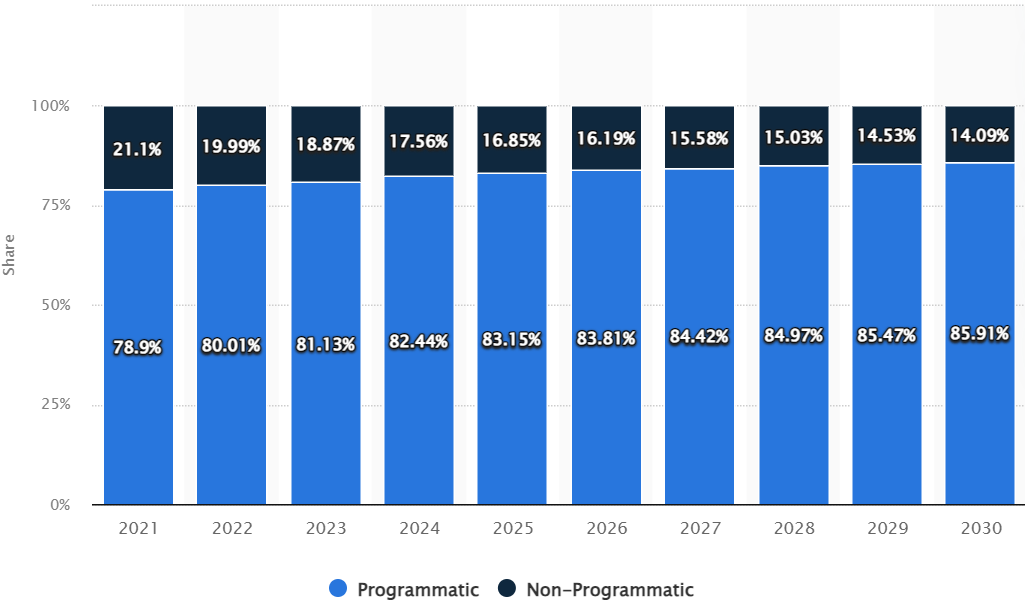
2. In digital advertising spending worldwide, programmatic advertising’s share will steadily grow compared to non-programmatic means in the coming years.
3. In digital advertising spending worldwide, programmatic advertising’s share will steadily grow compared to non-programmatic means in the coming years.
3. According to eMarketer,
- Programmatic display ad spending is projected to rise from $253.31B in 2022 to $435.86B in 2026, displaying a 72% increase over four years.
- By 2026, programmatic methods will account for 90% of all digital display ad spending worldwide.
- The highest annual growth rate was in 2024 (16.7%), after which growth is expected to slow down to 12.6% in 2026, signaling a maturing market.
- The share of programmatic transactions rises steadily each year, from 86.1% in 2022 to 90% by 2026, showing near-total automation of digital display buying.
Now without further ado, let’s delve into trends in programmatic advertising.
12 Programmatic Advertising Trends to Watch in 2026
Trend #1: First-party Data Utilization
Cookies are being pushed away because of privacy concerns; thus, finding alternatives for the third party is a pressing concern for the publishers. Still, you will be surprised to know that, as per Adobe’s research, 74% of marketers still relied on third-party cookies.
As publishers search for viable alternatives to third-party cookies, one solution that has emerged is Google’s PPID (Publishers Provided Identifiers).
So, marketers should embrace cookieless alternatives to save themselves from potential disruptions to their advertising campaigns.
Trend #2: Identity Graphs and Data Clean Rooms
With privacy concerns looming over the AdTech industry, publishers and advertisers must always be on their toes. Ergo, marketers are increasingly using data clean rooms and identity graphs to leverage first-party data to its fullest potential.
An identity graph is a database that connects different identifiers (like email addresses, cookies, device IDs, or login info) belonging to the same person. It maps and connects signals and touchpoints associated with a single user across platforms and devices. On the other hand, Data clean rooms facilitate the secure exchange of first-party data between publishers and advertisers.
When combined, they form a powerful duo for creating and activating user profiles without invading their privacy. And the results are visible. To better assess campaign results, Booking.com and Snap collaborated to use Snowflake Data Clean Rooms. Through this partnership, their confidence in their findings rose from less than 20% to an astounding 99%.
Trend #3: Contextual Intelligence + AI Intention Model
Contextual targeting is evolving; it’s moving from targeting a webpage’s keywords to mapping its intent. Contextual intelligence uses AI to analyze the environment where the ad will appear. It goes beyond basic keyword matching by considering the meaning, sentiment, emotional tone, images, and overall context of the content. This helps in aligning ads for relevance and brand safety.
Tools developed based on this framework are the AI intention models. Instead of just matching ads to what is on a page, intention models analyze what the user is likely looking to do: casual scrolling, considering a purchase, or actively shopping.
Many advertisers are already seeing the results. Nissan Spain teamed up with SeedTag to put the Nissan Qashqai front and center for C-SUV shoppers. By using intent-based audience segmentation in their campaign, they cut cost per quality lead by 68%, lowered cost per lead by 35%, & increased the number of qualified visits by 3x.
Trend #4: AI in Advertising (Gen+Agentic)
That era is not far where a part of a marketer’s success will be defined by their automated workflows. But why? Because that’s how efficient AI is. While generative AI can help a publisher with content creation, agentic AI can take their revenue to the finish line.
Agentic AI has changed how publishers view ad monetization. It has led to intelligent ad placements, automated A/B testing, ad layouts, ad performance forecasting, and optimization for page latency. Agentic AI in programmatic advertising has also increased publishers’ AdOps teams’ real-time responsiveness.
Many are now benefiting from the results as well. For example, according to Vladyslav Lazurchenko, CEO of JackpotSounds, Agentic AI can yield up to 20–30% more than conventional rule-based optimizers. So, if you plan to ace your 2026, start with automated workflows.
Trend #5: DPO+SPO
Supply path optimization has been a buzzword in AdTech for quite some time. It’s a process advertisers use to optimize their path to quality inventory. However, even publishers are here to level the playing field with their own version of SPO — Demand Path Optimization. The process is almost the same, but publishers do it to reach advertisers.
With the lines blurring between SSPs and DSPs, publishers are doing everything they can to reduce intermediaries and cut overhead costs. According to us, DPO will be one of the programmatic advertising trends that define 2026.
Trend #6: Sell-side Curation
Another 2026-defining programmatic advertising trend for publishers is sell-side curation. It’s part of sell-side decisioning, in which inventory is bundled and data-enriched before being offered to advertisers. But why call it sell-side curation? Because it shifts the curation task from DSPs to the SSPs.
Sell-side curation not only helps publishers stay within the ambit of SPO but also reduces reliance on third-party cookies. Publishers who hop on the bandwagon early on will surely gain an upper hand in the coming years.
Trend #7: Attention Metrics
As the programmatic advertising landscape continues to grow, marketers are increasingly shifting from traditional metrics to attention metrics. This has clearly come from the need for quality amidst the growing quantity.
Attention metrics help advertisers and publishers understand the user-ad dynamics beyond viewability. It measures whether an ad was noticed, understood, and remembered by the user.
Adelaide claims that attention-driven tactics can boost lower-funnel performance by 55% and upper-funnel performance by 41%, increasing awareness and conversions. It’s clear that attention metrics are not vanity metrics, but real growth indicators. Hence, if you want to make a mark, 2026 is the year to switch to attention metrics.
Trend #8:Omnichannel Targeting
While omnichannel targeting is mainly discussed among advertisers, it’s increasingly a concept publishers should be aware of as well. For marketers, the sky is the limit; they are shifting from cross-device targeting to omnichannel targeting. One of the significant reasons behind the rise of omnichannel targeting is the emergence of MadTech (AdTech + MarTech).
Companies like StackAdapt have already started experimenting with omnichannel targeting. It has recently introduced email marketing to its platform, allowing advertisers to unify display, native, connected TV (CTV), digital out-of-home (DOOH), and email campaigns within a single workflow.
By tapping into the user’s touchpoints, such targeting tactics can drive conversions in real-time.
Trend #9: Outstream Video Ads
One of the programmatic advertising trends shaping 2026 for website publishers is outstream ads. As in-stream video ads are restricted to video environments, out-stream video ads and accompanying content ads will continue to see an uptick in use.
These ads offer multiple benefits to publishers: a native-like look, compatibility with non-video environments, and freedom from the limitations of pre-roll ads.According to Epom, out-of-stream video advertising has a longer engagement rate and a greater click-through rate than in-stream video advertising.
As publishers explore ad formats to increase engagement and revenue, outstream video ads can help them achieve their goals.
Trend #10: Sustainability in AdTech (Green AdTech)
Sustainability has been one of the prime initiatives of the advertising stakeholders. Moreover, modern consumers, especially Gen-Z, are showing their concern towards environmental care. A study found that the advertising industry is responsible for 2% to 4% of greenhouse gas emissions, which is at par with the aviation industry.
Programmatic advertising is wholly based on machine learning, a process that utilizes high processing power. A huge amount of energy is consumed when data is shared across ad servers. For example, A single programmatic display ad impression may encounter up to 135 bids.
With that being said, more and more companies are coming forward with their sustainability initiatives to reduce carbon emissions. According to an AdExchanger article, reducing scope 3 emissions—which are emissions generated by supply chain partners—rather than the reporting company’s direct emissions, is the main goal.
MediaVine has joined Ad Net Zero to make its work processes more sustainable. On the other hand, InMobi Advertising has joined hands with Sope 3 to decarbonize its media and advertising.
You can also refer to articles by Forbes, The Financial Express, and MarTech to know more.
Trend #11: Privacy-first Platforms
Privacy has been a central point in programmatic advertising. Apart from embracing first-party data, more initiatives are being taken to comply with data privacy laws like GDPR.
According to research, 72% of Americans support increased privacy regulations.
The growing unease among users on unchecked data harvesting has prompted the industry to develop privacy-first platforms. So much so that according to a study done by BCG, 72% users would avoid buying from a brand or using their services due to privacy concerns. Implementing clear and transparent terms of use can also help build user trust and demonstrate a brand’s commitment to responsible data practices.
The AdTech industry has come up with many publisher-centric privacy-first platforms like AirGrid to mitigate this shift. Moreover, firms like Lotame have also introduced cookie less DMPs that fully rely on first-party data. These platforms are known to keep user privacy at the center of their operations.
The changes offer publishers an opportunity to regain control over their data and safeguard their ad revenue via sustainable monetization practices.
We can see that the prevalence of privacy-first platforms will only increase in the coming years. Complying with these changes will smoothen the ad delivery process and enhance ad performance. Hence, it’s never too late to hop on the bandwagon.
Trend #12: Programmatic Audio Ads
The last in our list of programmatic advertising trends 2026 is programmatic audio ads. As streaming services become increasingly popular with customers, demand for digital audio advertising is rising globally.
According to Statista, the digital audio advertising market is expected to grow at a compound annual growth rate (CAGR) of 5.62%, reaching US$14.84 billion by 2029.
The rise in podcast usage and the popularity of audio streaming services like Spotify have significantly opened up new markets for programmatic audio advertising.
Audio advertisements are especially useful in reaching your audience during activities where visual ads are impractical. These ads provide a distinctive means of connecting with people without being intrusive. Companies like Amazon have also joined the league by introducing interactive audio ads to engage their audience while delivering relevant and impactful ads.
As we move towards 2026, we will see more applications of programmatic audio ads. This rise in the trend provides publishers with a unique opportunity to explore newer formats to engage their visitors without seeming irrelevant.
Quick Recap:
Publishers must embrace first-party data, identity graphs, and data clean rooms to ensure privacy compliance. AI-driven contextual targeting and agentic AI boost performance. Demand Path Optimization empowers publishers, while attention metrics shift focus to user engagement, shaping a smarter, efficient programmatic future.
Before you leave, we’d like to do a little self plug about ourselves too. Take a look at what AdPushup does and why we’re hand-picked by Google as a certified publishing partner.
AdPushup is a Google Certified Publishing Partner. Over the years, we have helped web publishers sustainably increase their ad CTRs, CPMs, and overall revenues without compromising on UX.
Got a minute? Take a look at how we delivered a 534% ad revenue uplift in 6 Months for CCNA7. If you want to learn how our technology can do the same for you, go ahead and request a demo.
FAQs – Programmatic Advertising Trends
Programmatic advertising is the automated buying and selling of ad inventory through a software platform. This technology allows advertisers to target specific audiences and optimize their real-time ad placements.
Programmatic advertising is revolutionizing the way that brands and publishers approach digital advertising. With its ability to target specific audiences, measure campaign effectiveness in real-time, and automate the buying and selling process, programmatic advertising is becoming an increasingly popular option for advertisers looking to connect with consumers in more impactful ways.
Some of the most prominent emerging trends in programmatic advertising include the increased use of AI in advertising, omnichannel targeting, increased focus on green AdTech, and the rise of identity graphs and data clean rooms in the wake of the decline of third-party cookies.