
The frustration is real. Traditional display ads get ignored. Pop-ups annoy users. Full-screen interstitials trigger Google penalties. Publishers need ad formats that generate revenue without destroying user experience.
Publishers are left with a challenge: how to earn revenue without harming user experience.
This is where interscroller ads come in. Seamless, mobile-first, and compliant with ad experience guidelines, interscrollers have emerged as a high-performance, revenue-boosting format.
In this guide, we’ll show you what they are, how they work, and most importantly, how publishers and advertisers can implement them to maximize ROI.
Key Takeaways from the Blog
- Interscroller ads are mobile-first, user-friendly, and Google-compliant.
- They outperform banners and interstitials in engagement and CPMs.
- Eye-on view time for interscroller ads is up to 3x longer than standard display ads.
- AI and privacy-first targeting will make interscrollers even more powerful in the future.
What Are Interscroller Ads? (Definition + Why It Matters)
Interscroller ads are native-style, scroll-activated ads that appear between content sections on mobile devices. Also known as flying carpet ads, they gradually reveal themselves as users scroll, and at 85% visibility they can expand into a full-screen experience.
📱 How Interscroller Ads Look on Mobile
Tap or watch the finger swipe to see the ad reveal ↓
Readers start with the article content…
They scroll further down the page…
Sponsored Ad
Beautifully integrated inside mobile reading.
And the article continues seamlessly after the ad.
Unlike interstitial ads that block the screen, interscrollers let the user stay in control. A simple scroll continues the reading journey, making them non-intrusive, yet highly engaging.
They are also 30% more potent in drawing and retaining the user’s engagement and attention. After all, stats show how the largest appealing ads capture the most attention, which may span up to 6.6 seconds, for ads that cover 80% of the phone screen.
This seamless ad experience directly aligns with Google’s algorithm updates targeting intrusive ads. Since Google’s September 2022 update, the algorithm penalizes publishers using intrusive forms of interstitial ads. As Google states: “Pages where content is not easily accessible to a user on the transition from the mobile search results may not rank as highly.”
6 Benefits of Interscroller Ads
Now that we know how interscroller is a better choice than interstitial ads, let’s discover in detail the benefits of this revolutionary ad format.
1. Increased Eye-On View Time
The figures on interscroller advertisements do not lie. A study by MOKOBI in collaboration with Lumen Research revealed that interscroller ad formats had an eyes-on view time 2.4x – 3x longer than that of a regular mobile display ad.
Moreover, it also found that the brands utilizing the ad format saw a significant rise in spontaneous and prompted brand memory as a result of these full-screen advertisements. Hence, in today’s times, where a second of user’s attention can make a difference, interscroller ads skillfully capture their attention and bring results.
2. Naturally Blending and Engaging
Interscroller advertising looks less like advertisements and more like the natural extension of the content itself, where it blends in effortlessly. Moreover, these are interactive, in the sense that advertisers can hook up the user’s attention, who wouldn’t be busy hyper-focusing on the skip ad button.
They are also captivating due to the fact that these ads are usually a unique culmination of audio and visual content or animation that tends to grasp more attention than lengthy and familiar video ads.
3. Mobile Responsive
The ad format is mobile responsive, designed to fit the screen size, regardless of the device’s variation. Thus making it easier on the publisher’s end. This is a very valuable feature for operating cross-platform campaigns that require the same ad creative to be used across several channels.
4. Building Consumer Trust
Let us give an example of a situation where you deal with 2 sellers. Who does the customer trust more? The seller is swift, concise, and has few but solid selling points. Or the seller that keeps persisting you from buying the item?
Obviously, the first one, because the latter, seems like a shady option. This is also the psychology the interscroller ad success lies on.
As these ads are seamless, short, and effective enough to retain the user’s attention span for a longer period without forcing any of it, the user gets a sense of their decisions and needs being respected, and they willingly make a click-through completely on their will.
5. Aesthetically Pleasing Design
One of the highlights of interscroller ads is their aesthetics. Featuring a clean layout that seamlessly blends with the surroundings, the format has a visually appealing design that’s pleasing to the eyes.
This creates a non-intrusive yet captivating experience that draws users’ attention without disrupting their browsing flow, enhancing both brand perception and user engagement.
6. Premium Demand
Due to its proven ability to deliver high engagement rates and CTR, interscroller ads attract premium advertisers who are ready to pay handsome eCPMs to make their campaigns a success.
This strong demand translates into higher revenue opportunities for publishers, making interscroller ads a valuable addition to any monetization strategy.
🚧 Common Technical Pitfalls & How to Avoid Them
Problem: Ad triggers too early or too late in scroll sequence.
Solution: Test 85% visibility threshold across different screen sizes.
Problem: Heavy creative files slow page load times.
Solution: Implement lazy loading and optimize creative file sizes.
Problem: Ad doesn’t render properly on all mobile devices.
Solution: Use responsive design principles and test across device matrix.
Interscroller vs Banner Ads
📊 Interscroller vs Banner Ads
| Feature | Interscroller Ads | Banner Ads |
|---|---|---|
| ℹ️ What are they? | Native-style ads that blend seamlessly into content breaks | Traditional static/animated graphics in fixed sizes |
| 🎯 User Experience | Integrated and engaging; less intrusive 🏆 Winner | Less intrusive than popups but prone to banner blindness |
| ⚡ Performance | Higher engagement, CTR, eCPMs | Lower CTR & engagement |
| 👨💻 Implementation | Can be tricky; often needs AdOps support | Easy to implement with simple code |
| 🌐 Availability | Limited availability; not on all networks | Widely available across all networks |
| 📱 Supported Devices | Mobile only | Available on all devices (desktop/tablet/mobile) |
| ✅ Verdict |
Interscroller Ads outperform Banners in 3/6 key areas (UX, Performance, Engagement).
Boost Revenue up to 40% with Adpushup Innovative Ads |
|
Interscroller vs. Interstitial Ads
Both ad formats certainly have a pack full of advantages to offer. While proper use of interstitial ads can be impressive for your audience engagement rates, so can interscroller ads which also account for a better user experience, as it leaves the control with them.
So here are some more differences between the two to help you decide better:
📊 Interscroller vs Interstitial Ads
| Feature | Interscroller Ads | Interstitial Ads |
|---|---|---|
| 🖥️ Screen Coverage | Covers screen only when ~85% of the ad is in view 🏆 Winner | Covers the entire screen instantly |
| 🌐 Availability | Primarily on mobile; rarely on desktop | Mobile and desktop |
| ⏩ Skip/Close | User can scroll past anytime (low intrusiveness) 🏆 Winner | Skippable, usually after 5–15 seconds (high intrusiveness) |
| 🎯 User Experience | Smooth, non-disruptive as natural placement encourages interaction 🏆 Winner | Often frustrating or disruptive; can grab attention but risk annoyance |
| ⚡ Click-Through Rate | Moderate to high | High, but can lead to bounce |
| 📑 Contextual Fit | Appears within content stream, matches surrounding material 🏆 Winner | Often detached from content, appears at transition points |
| ⚠️ Risk Factors | Minimal as it is unlikely to trigger penalties 🏆 Winner | Risk of being penalized by Google for intrusive formats |
5 Step Guide to Implement Interscroller Ads
Step 1: Choose an Ad Network
Select a reliable ad network that supports interscroller ad formats.
AdPushup: Offers AP Tags with dedicated account management
Ensure that the chosen network aligns with your website’s content management system (CMS) and technical specifications, including minimum traffic requirements and revenue share terms.
Step 2: Create Your Ad Creative
Design your interscroller ad using supported formats:
Static formats: GIF, JPG, PNG for lightweight loading
Rich media: HTML5 for interactive elements and animations
Video formats: MP4 for dynamic storytelling content
Creative Specifications:
Optimal dimensions: 640 x 1280 pixels (mobile-optimized ratio)
Alternative size: 336 x 600 pixels (commonly supported)
File size limit: Maximum 500KB for optimal loading speed
Design principle: Ensure creative is visually appealing and fits well within content breaks
Step 3: Set Up Your Campaign
Log into your selected ad network’s dashboard and create a new campaign:
Enter campaign parameters including targeting options, budget, and duration
Upload your interscroller ad creative as a template
Define audience targeting based on demographics, interests, and behavioral data
Set geographic and device targeting (mobile-first approach)
Step 4: Configure Ad Settings
During campaign setup, configure specific interscroller parameters:
Ad naming: Use descriptive names for easy campaign management
Format selection: Choose interscroller/flying carpet type from available options
Customization options: Select between customizable or pre-populated ad templates
Dimensions and positioning: Adjust settings to ensure smooth content integration
Trigger settings: Configure 85% visibility threshold for optimal viewability
Frequency capping: Set session limits to prevent user fatigue (recommended: 1-2 per session)
Step 5: Implement the Ad Code
After ad approval, the network provides implementation materials:
Web integration: Insert provided JavaScript tag into HTML at designated content breaks
Mobile app integration: Use provided SDK (Software Development Kit) for native app implementation
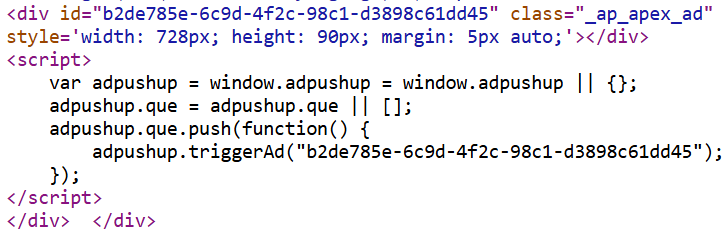
Publishers can use one of our popular ad monetization solutions – AP Tags – to deploy interscroller ads on their website. Here’s a snippet of how AP Tags look:
Best Practices for Interscroller Ad Units
Implementing Interscroller ad units effectively involves adhering to key best practices that prioritize user engagement and seamless integration. Some of them are:
- Our AdOps team suggests 336×600 as the best dimensions for implementing interscroller ads within their websites.
- Place interscroller ads only at logical content breaks – between articles, after complete thoughts, or at natural story transitions. Avoid interrupting mid-paragraph or mid-sentence as this creates jarring experiences that can increase bounce rates.
- Conduct A/B tests to identify the optimal placement of interscroller ad units for improved performance. This will also ensure industry-standard compliance, thereby maintaining a positive reputation.
- Always include prominent “Advertisement” or “Sponsored Content” labels to maintain transparency and comply with industry guidelines. Make these labels visually distinct but not intrusive to the overall design.
- Ensure interscroller ads are fully optimized for viewability by triggering only when sufficient screen real estate is available.
- Adjust interscroller frequency based on content length. Longer articles can support more placements, while shorter pieces should have minimal or no interscroller ads to avoid overwhelming the content.
Other Alternatives to Interscroller Ads
No one has an obligation to stick to one ad format for their website. While you can use interscroller ads, you can always opt for other ad formats for the desktop version or mix and match them up for your mobile itself. And here are some other suitable options for you to try than interscroller or interstitial:
| Format | Viewability | Avg. CPM | CTR | User Experience | Complexity |
|---|---|---|---|---|---|
| Interscroller | 85–95% | High | High | Seamless, non-intrusive | Moderate |
| Interstitial | 90–100% | Moderate–High | High but risky | Disruptive, often penalized | Easy |
| Banner | 35–55% | Low | Low | Prone to banner blindness | Easy |
| Rewarded Video | 90–100% | High | Very High | Opt-in but limited use cases | High |
The Future of Interscroller Ads & AI Optimizations
AI is now transforming the advertising . In previous articles, we’ve explored how AI intention models help marketers deliver the most relevant ads to users without raising privacy concerns.
As privacy-first solutions like Google Privacy Sandbox gain traction, interscroller ads remain a safe and effective choice for publishers.
Let’s explore the future of interscroller ads and how AI-driven optimizations are shaping what’s next.
Privacy Sandbox Integration
Cookieless Future Preparation: Interscroller ads are well-positioned for Google’s Privacy Sandbox implementation. The format’s contextual nature reduces dependency on third-party cookies while maintaining targeting effectiveness through Topics API integration.
First-Party Data Optimization: Publishers can leverage first-party behavioral data to optimize interscroller ad performance without compromising user privacy, creating sustainable revenue streams in the post-cookie era.
AI-Powered Personalization
Dynamic Creative Optimization: Machine learning algorithms now analyze user behavior patterns in real-time to serve personalized interscroller creative variations. This includes adjusting color schemes, messaging, and call-to-action text based on user engagement history.
Predictive Performance Modeling: AI systems predict optimal interscroller placement timing by analyzing individual user scroll patterns, content engagement depth, and historical interaction data.
Frequently Asked Questions
Google Ad Manager doesn’t natively support interscroller ads. Publishers must partner with specialized SSPs and adtech vendors like AdPushup, PubMatic, or InMobi who offer interscroller formats and provide custom implementation code.
Interscroller ads are primarily designed for mobile devices, though some networks offer desktop variants with limited availability and effectiveness.
Best practice recommends 1-2 interscroller ads per page, with frequency adjusted based on content length and user engagement patterns.