
Programmatic advertising can feel chaotic with thousands of buyers, millions of bid requests, prices shifting every second. But behind all that noise, publishers have more control than they realize.
How you choose to sell an impression matters just as much as who you sell it to. The right programmatic advertising deal type gives you stability, transparency, and stronger pricing power. The wrong one leaves value on the floor.
Here’s how to use each of the four programmatic deal structures to your advantage.
Key Takeaways (TL;DR)
- Programmatic deals are the foundation of automated ad trading, publishers and advertiser must understand each type to maximize yield and control.
- Open Auction offers broad scale and easy setup, but can yield the lower eCPMs due to oversupply and competition.
- PMP Deals provide invited buyers priority access to premium inventory, boosting CPMs, transparency, and demand quality.
- Preferred Deals offer a first-look fixed-price option for a single buyer, which is great for targeted demand but carries fill-rate risk.
- Programmatic Guaranteed secures guaranteed impressions at a negotiated price—ideal for high-value placements and predictable revenue.
- There is no universal “best” deal type—your choice directly affects CPMs, inventory control, and buyer relationships.
What Is Programmatic Advertising?
Programmatic advertising is the automated buying and selling of ad inventory using real time bidding (RTB) and data-driven decisioning.
Instead of manual negotiations, programmatic process matches the right impression to the right advertiser in milliseconds. The matchmaking is based on user behavior, demographics, context, and campaign goals.
For publishers, programmatic is not just an automation tool. It is a way to:
- Increase competition for impressions
- Improve yield through better pricing
- Maintain control over inventory packages
- Reduce dependency on direct sales
Once you understand this, the next step is choosing which deal type fits your inventory strategy and increases ad revenue.
Quick Quiz: Programmatic Basics
Q: What best describes programmatic advertising?
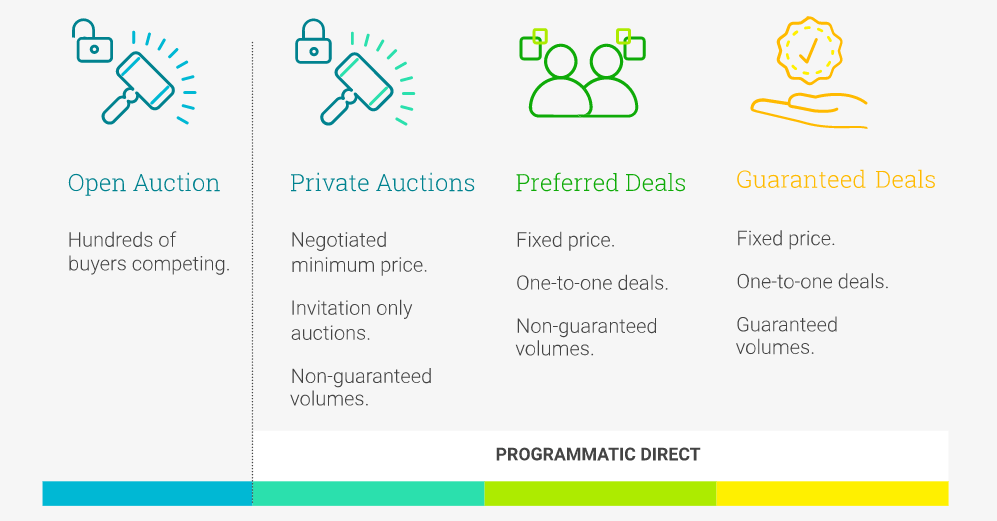
Open Auction vs. Private Auction vs. Preferred Deals vs. Programmatic Guaranteed.
Deal Types Comparison
| Deal Type | Best Used For | Why |
|---|---|---|
| Open Auction (RTB) | Remnant inventory | High demand access, easy optimization |
| PMP Deals | Premium inventory packages | Higher CPMs + more transparent buyers |
| Preferred Deals | Buyers with specific targeting goals | First-look access at stable pricing |
| Programmatic Guaranteed | Top-tier placements | Guaranteed revenue + full control |
Publishers can build a sustainable advertising-based publishing business with a stronghold on both direct and automated selling. Knowing how to trade your inventory will allow you to fetch higher rates for your inventory and potentially strengthen relationships you use for manual direct selling once you’re competent enough.
4 Types of Programmatic Deals
By understanding these deal types, publishers can choose the right strategy to maximize revenue, protect brand integrity, and create a reliable platform for users and demand partners. There are various programmatic deal types that publishers can leverage, depending on their objectives and advantages. Let’s explore
Open Auction (Real-Time Bidding)
Also known as Open Exchange, open marketplace, real-time bidding
Participation: All (eligible) buyers on a platform
Priority: Ad servers set RTB at the lowest priority
Transactional Cost: 10-20% (SSP) 10-30% (DSP)
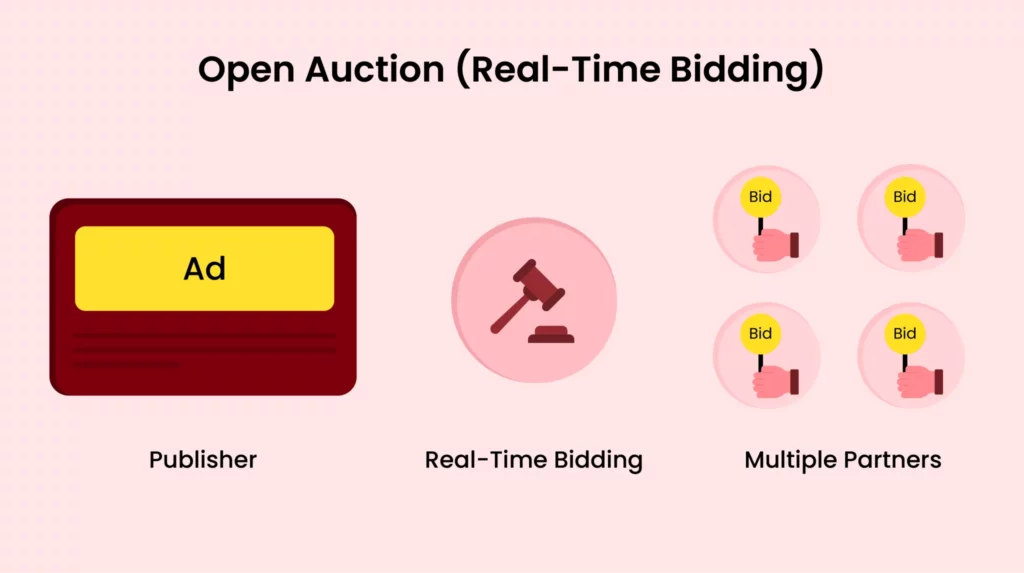
Open Auction or RTB is exactly what it sounds like. Publishers take a part of their inventory to the open market for multiple demand partners to bid on it.
It might sound chaotic; however, RTB is managed in a controlled environment. Publishers are allowed to choose the specific ad units to be placed in the open auction. Next, they can block advertisers and filter ad types as per their requirements. And most importantly, they get to choose the floor price for their inventory.
Similarly, buyers are allowed to set up a campaign before the actual bidding starts; this saves them time and helps them improve on the targeting front of the business.
Recommendation: Publishers are advised not to blindly put their ad units up for open auction. Ideally, remnant inventory is best handled by a real-time auction.
Here are some pros and cons of an open auction that you should know:
Pros
- Efficient for Remnant Inventory: Helps fill unsold inventory at scale.
- Fast Setup: No negotiations or deal IDs required.
- Flexible Optimization: Real time adjustments to floor price, creative controls, and bidder settings.
- Broad Demand Access: Ideal for publishers with mixed or broad audiences.
Cons
- Data Exposure Risk: In RTB auctions, the bid is available for varied advertisers to bid. This increases the chance of data leakage. A bid request stores a lot of data, like publisher details and user demographics (cookie data). However, now we have data policies (GDPR and CCPA) and security measures to protect users from such malpractice..
- No Pricing Guarantee: If the floor price is too high and/or inventory is not relevant for the available demand partners, it can still go unsold. Thus, eCPMs can fluctuate based on supply and demand.
- Higher Risk of Malicious Ads: Broader access increases exposure to questionable buyers like fraudsters. They keep an eye on vulnerable inventories to push their malicious creatives. And, pinpointing the source can be difficult, due to media arbitrage and transparency issues.
- Lower eCPMs: Open exchanges have a much larger supply of impressions. Oversupply in the open market puts pressure on prices.
Quick Quiz: Open Auction (RTB)
Q: Which statement is true about Open Auction?
Private Marketplace Deals (PMP Deals)
Also known as: Closed auction, private auction, invitation-only auction
Participation: Only invited buyers are allowed
Priority: Ad servers place private auctions at a higher priority than open auctions
Transactional Cost: 10% (SSP), 10-20% (DSP)
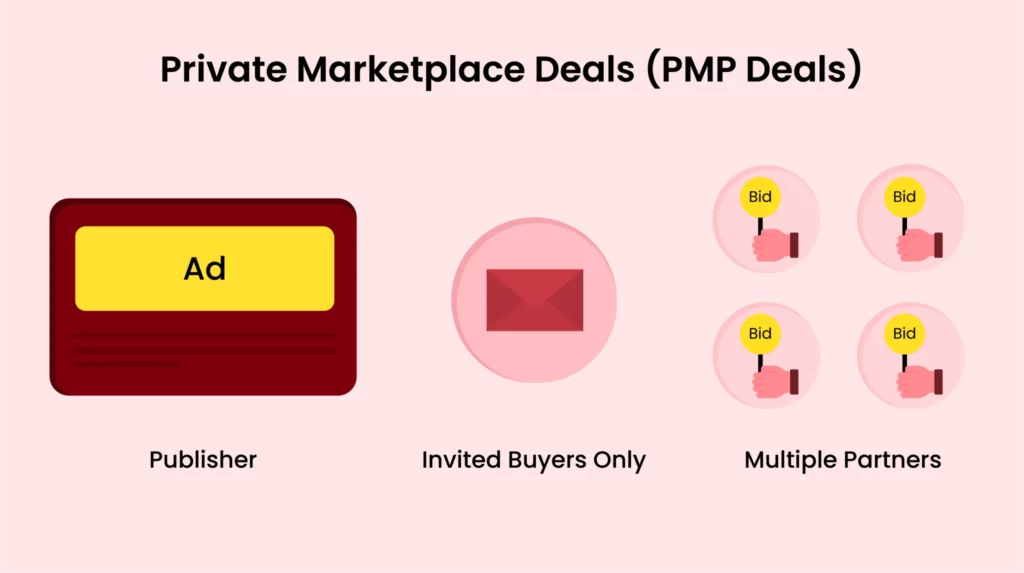
What is a PMP deal? It is an invitation-only real-time auction. Publishers send an invite to various advertisers and demand partners to place their bids on the available inventory.
Within the private marketplace, buyers participate in the deal with ‘first look’ criteria and then decide whether to buy it or not. Meaning, before making any promise to purchase the inventory, the buyer is first allowed to check the inventory to see whether it matches the buyer’s requirements or not. The invitation-only process makes the deal safer than the open auction. Publishers invite only trusted demand partners for the auction. PMP inventory is labelled ‘premium’ and offers differentiated ad inventory packages (built around audience data, impression attributes, content type, and more) to a group of buyers pre-approved by the publisher.
Mandatory use of Deal ID: In a private auction, the deal ID is mandatory and used to identify the seller and buyer during the auction. It is a unique string of characters defining things like priority, transparency, floor pricing, or data (depending on the platform you’re using). It is assigned to the inventory package, which allows it to be purchased programmatically through a DSP (Demand Side Partner).
Pros:
- Transparency: Thanks to the deal ID, sellers and buyers are able to identify each other at the point of the exchange. Buyers know what type of inventory they are getting. And sellers know who is placing ad creatives on their sites/apps.
- High CPM: Two factors make private marketplace deals more profitable: premium inventory and chosen advertisers. Premium inventory has higher ad viewability and user involvement. And chosen advertisers are willing to pay in good numbers for such placements. Hence, leading to comparatively better CPM for publishers.
- Fraud Prevention: Since the publisher and seller are directly involved in a deal, there is less chance of fraud, ensuring the safety of user data.
- Automated: It’s not plug-and-play like an open auction, but PMP deals are still automated among DSPs and SSPs, which means they’re less labour-intensive than direct sales.
- Better Buyer Relationships: Publishers and buyers can negotiate the terms and agree according to their mutual understanding. This gives them time to build strong relationships, resulting in a beneficial exchange between the two parties.
Cons:
- Difficulty Maintaining High-Quality Inventory: Advertisers will only agree to a good price if they find your inventory ‘premium’ enough. Otherwise, you might end up negotiating at a lower price. It may be difficult to maintain a high enough fill rate to surpass open auction revenue.
- Miss out on opportunities: It is possible that some high-paying advertisers don’t get to make it to the list of publishers because of a lack of information on the publisher side.
Quick Quiz: Private Marketplace (PMP)
Q: What distinguishes a PMP deal from Open Auction?
Preferred Deals
- Also known as: Spot buying, private access, unreserved fixed rate
- Participation: One buyer
- Priority: Ad servers put preferred deals over the private and open auction
- Transactional Cost: <10% (SSP), 10% (DSP)
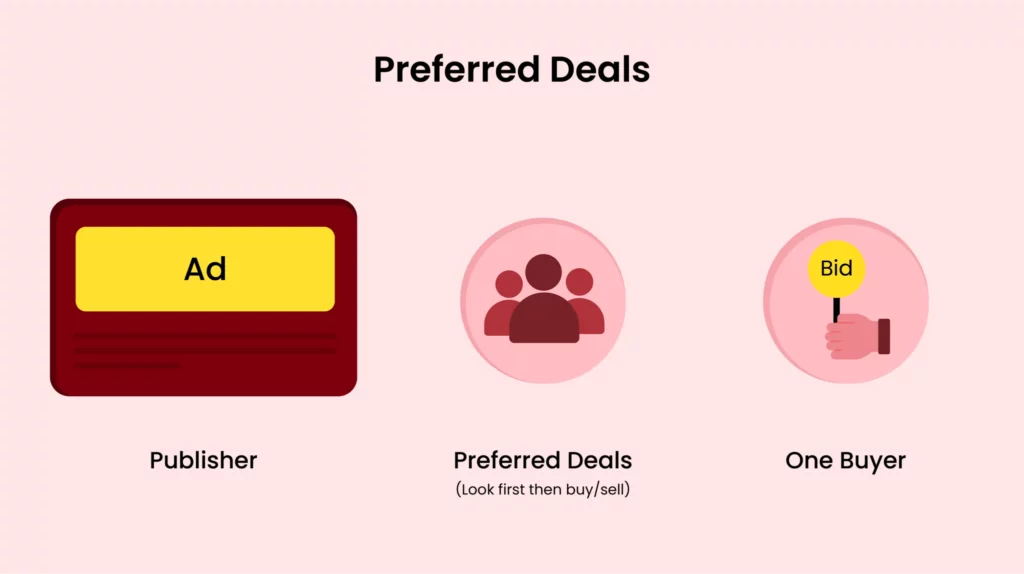
Under Preferred deals, the buyers get priority and exclusive access to inventory, at the cost of a pre-negotiated fixed price, before you make it available to everyone else in private and then open auctions.
The number of impressions is not guaranteed, but the audience is. Since buyers’ DSPs can use their audience data to review every ad impression before they decide to buy it.
Pros:
- Highly Targeted Ads: Impressions won in preferred deals are shown to very specific audiences enriched by DSP data, making it more relevant to your visitors.
- Better Buyer Relationships: Buyers reach out directly to publishers for the first-look privilege and price negotiation. Negotiation and speculation make parties build rapport.
- Creative Control: Publishers can review and approve the campaign creatives beforehand.
Cons:
- Low Fill Rate: Buyers have the liberty to cancel the subscription anytime. If that happens, inventory will go directly to the open auction. For this reason, it’s important to price and segment the inventory appropriately.
- Downfall Risk: With less competition, the impressions bought in preferred deals may get sold at a lower price.
Quick Quiz: Preferred Deals
Q: Which describes Preferred Deals correctly?
Programmatic Guaranteed Deals
Also known as: Automated guaranteed/direct / premium / reserved
Participation: One buyer
Priority: Highest ad server priority
Transactional Cost: 3-5% (SSP), 10% (DSP)
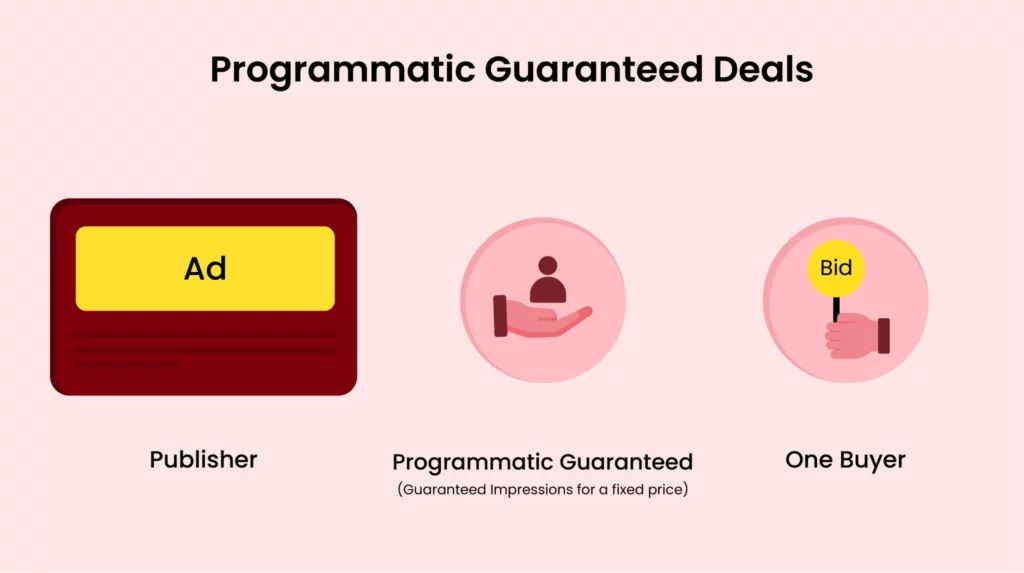
What is programmatic guaranteed? Programmatic or automated guaranteed is where the premium inventories are exchanged. The publisher chooses one buyer and guarantees a number of impressions for a fixed (negotiated) price.
As the seller and buyer deal directly, it eliminates the chances of fraud. Next, for a fixed number of impressions, publishers get a good price for their inventory. And in the long run, publishers get to make better relationships with demand partners.
Programmatic guaranteed is different from direct deals. In direct deals, publishers keep control of inventory and present what they want to sell. However, in programmatic guaranteed deals, buyers are allowed to see all placements and choose as per their requirements.
Pros:
- Effective Use of Premium Inventory: Ad units with high user engagement and less banner blindness ought to be sold efficiently by publishers. This is where programmatic guarantees can help get a reasonable profit from the efforts of the publisher.
- Transparency and control: One-on-one dealing ensures control for the sell- and buy-side. Both parties are free to approve/disapprove of inventory or creatives. Because of this, parties can deal comfortably.
- Creative control: Direct dealing creates an opportunity for publishers to ask for creative reviews before the deal signing.
Cons:
- Underselling: Despite negotiating for highly valuable inventory served at top priority, publishers can’t accurately account for targeting parameters on the buyer side and/or viewability, which could lead to underpricing.
- Resource-intensive: Although everything is ‘automated’, publishers still need ad ops resources to make sure the campaign is executed as required.
Quick Quiz: Programmatic Guaranteed
Q: What makes Programmatic Guaranteed unique?
Adpushup and Programmatic Deals
Still wondering about a smart way to maximise your ad revenue? Adpushup is a revenue optimization platform that can help you get direct access to the large pool of premium advertisers, ensuring better ad placements and optimized ad revenue.
Programmatic Guaranteed: Our Standard and Sponsorship line items help you to sell all the impressions mentioned in your proposal.
Non-Guaranteed: Run via preferred deals, this setup allows buyer to buy an impression based on their targeting criteria. Then they can choose to buy or leave the inventory for other demand partners to fill in.
With Adpushup, you can control and optimize your ad inventory with the guidance of expert adops 24*7.
Key Takeaways
- Programmatic helps publishers automate the ad buying and selling process, with a strong emphasis on control, flexibility, and efficiency.
- With programmatic making up 82.21% of digital ads, understanding your deal options is more important than ever.
- Programmatic deals are bifurcated into 4 types: Open Auction (RTB), Private Marketplace deals (PMP), Preferred deals, Programmatic Guaranteed Deals.
- The open Auction (RTB) functions as an open marketplace for demand partners to buy and sell ad inventory, which often comes at the cost of lower eCPMs.
- PMP Deals are very exclusive as they include only invited demand partners to take part in the buying and selling of ad inventory. PMP deals often translate into higher CPMs, more transparency less ad fraud as it includes invite-only buyers.
- As the name suggests, preferred deals allow a single buyer the opportunity to buy inventory before it becomes available to the open market.
- Programmatic guaranteed is an exclusive way to sell ad inventory, including a single buyer negotiating a fixed price for guaranteed impressions.
Frequently Asked Questions
In Programmatic, deals are automated ways through which publishers and advertisers can buy and sell ad inventory. There are 4 types of programmatic deals:
1) Open Auction or RTB programmatic deal
2) Private Marketplace (PMP) Deals
3) Preferred Deal
4) Programmatic Guaranteed
Programmatic advertising allows publishers and advertisers to buy or sell ad inventory, then serve ad impressions to the audience through predefined automated methods, in mere seconds. Programmatic helps advertisers to target relevant audiences across various platforms like websites, mobiles, apps, video, etc.
Programmatic Guaranteed is when a buyer negotiates a price for inventory that’s reserved for a buyer. The Preferred Deal is when the buyer negotiates a price for inventory that the buyer can optionally buy.